Crop guide · The cabbage family

How to grow Kohlrabi

A fast cabbage-family vegetable grown for its swollen stem — a crisp bulb that sits above the soil and eats like a sweeter, milder broccoli stalk.

Brassica oleracea var. gongylodes · also called German turnip, Turnip cabbage

Full sun Beginner Frost-hardy
Sun
Full sun
Light afternoon shade once afternoons stay above 85 °F (29 °C) keeps the stem tender
Frost
Hardy
Takes repeated frost and brief spells near 20 °F (-7 °C) once sizing up
Spacing
6 in
15 cm between plants
Sow depth
½ in
13 mm
To harvest
50–70 days
counted from sowing
Timing

When to plant Kohlrabi

Windows are counted from the average date of your last spring frost.

Summer:mid to late summer, about 8–10 weeks before first fall frost.
Fall planting:in mild-winter areas, sow through early fall for winter harvests.
Too late?Skip a spring sowing once days regularly top 80 °F (27 °C) — bulbs turn woody. Wait and sow about 8–10 weeks before first frost.
Background

Why grow Kohlrabi

Ready in roughly two months, it works at both cool ends of the season and holds in the refrigerator for weeks without going limp. Raw slices are juicy and mild; roasted, the flesh turns sweet.

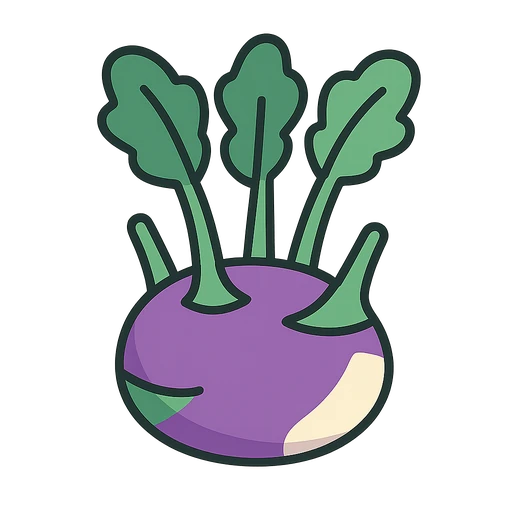
A little history. The bulb is a thickened stem, not a root, and forms above the soil line where the plant stores water and sugars. Same species as cabbage and kale, selected for stem swelling.

The season, step by step

From planting to harvest

Sow outside

3–4 weeks before last frost

Sow seeds ½ inch (13 mm) deep, and aim for 6 inches (15 cm) between plants once thinned. Cover seed ½ inch and keep the top half-inch damp until sprouts show. Break any dry crust with a light watering. Seedlings emerge in 4–10 days.

Best soil temp 65–75 °F (18–24 °C) Minimum 45 °F (7 °C) Emerges in 4–10 days

Transplant outside

Direct sow 3-4 weeks before last frost, or set out transplants started 5 weeks earlier

Either — shallow-rooted and content in 8–10 inches of soil depth. In containers: 3-gallon pot per plant, or a 10-inch-deep trough for a short row.

Water and feed

All season

Water steadily, roughly twice a week in warm weather. Water when the top inch of soil feels dry. Aim for about 1 inch per week including rain.

Feed at planting, then side-dress once when bulbs reach golf-ball size. What to use: compost plus a balanced 5–5-5 organic fertilizer.

Prune and maintain

As it grows

No pruning. Pull off yellowing lower leaves so air moves around the bulb, and leave the top rosette intact — those leaves size the stem.

Harvest and store

50–70 days from sowing

It's ready when bulbs are 2–3 inches across for standard varieties — tennis-ball size at most. Larger than that and the flesh turns fibrous and woody. Cut the stem with a knife just below the bulb, at soil level, rather than pulling. Trim leaves off immediately, keeping the smaller inner leaves for cooking.

Trim leaves, leave the bulb unpeeled, and refrigerate in a loose bag for 4–6 weeks. Storage varieties keep 3–4 months in a cold, humid cellar.

Companions

Good neighbours, bad neighbours

Plant it with

Beet

Kohlrabi feeds in the top few inches while beets pull from a deeper taproot, so the two can share a bed without fighting over the same water. Harvesting kohlrabi at soil level also leaves beet roots undisturbed.

Onion

The strong smell of onion foliage can make it harder for cabbage moths and root maggot flies to locate kohlrabi by scent. The effect is real but partial — treat it as a supplement to row cover, not a replacement.

Dill

Dill flowers draw in hoverflies, lacewings, and the tiny parasitic wasps that attack cabbageworms and aphids. Let a couple of plants flower at the row end rather than harvesting all the foliage.

Sweet Alyssum

A low edging of sweet alyssum flowers continuously and feeds adult hoverflies, whose larvae eat cabbage aphids. It stays short enough that it never shades the developing bulbs.

Nasturtium

Aphids often settle on nasturtium stems in preference to kohlrabi. It only helps if you check the nasturtiums weekly and cut off and destroy the infested shoots before the colony spreads.

Lettuce

Both want the same cool weather and steady moisture, and lettuce fills the gaps between young kohlrabi plants before the leaf rosettes spread. Cut the lettuce first and the kohlrabi takes over the space.

Keep it away from

Bell Pepper

Old companion charts keep kohlrabi away from peppers, with no mechanism ever demonstrated. The practical issue is timing and light: peppers want the heat that turns kohlrabi woody, and their bushy growth shades a crop that needs full sun.

Hot Pepper

The same long-standing chart pairing applies to hot peppers, and it is said to hold both ways. Neither crop is harmed by proximity as far as anyone has shown — but their seasons and sun needs simply do not line up.

Tomato

Gardeners have long separated kohlrabi and tomatoes, and no mechanism has been demonstrated. What is observable is competition: a caged tomato casts heavy shade and takes the water kohlrabi needs for steady, tender bulb growth.

Pole Bean

Old charts keep these apart without giving a reason that holds up. Practically, a bean trellis shades the row and picking beans means constant traffic over shallow kohlrabi roots.
Fennel

Fennel roots release substances that reliably stunt most garden vegetables, kohlrabi included. Grow it in its own corner or a pot — well apart, its flowers still feed hoverflies and tiny parasitic wasps.

Strawberry

Old charts keep strawberries and cabbage-family crops apart, with no mechanism established. A real concern is that a permanent strawberry patch cannot be rotated, which works against the 4-year gap kohlrabi needs.

See Kohlrabi in the full companion chart →

Crop rotation

After this crop

Family rest

Give the cabbage family 4 years away from this spot before any of its relatives return.

Good next crops

The tomato family, the pea and bean family or the carrot family thrive in this ground next season.

A heavy feeder that leaves little behind — follow it with peas or beans to rebuild nitrogen, or with tomatoes, peppers, carrots, or parsnips. Keep all cabbage-family crops out of this bed for 4 years to hold down clubroot and black rot.

Trouble to watch for

Pests and diseases

Pests

Imported cabbageworm

Sign
Velvety green caterpillars on leaf undersides, ragged holes, and dark pellets of droppings in the crown.
Fix
Cover the row with fine insect netting at sowing; hand-pick caterpillars or spray a Bt product for caterpillars.

Flea beetles

Sign
Tiny black beetles that jump when disturbed; leaves pitted with pinhole shot-hole damage, worst on seedlings.
Fix
Float row cover over seedlings until plants have 5-6 true leaves (the full-shaped leaves after the rounded seed leaves).

Cabbage aphids

Sign
Gray-green sticky clusters packed into the crown and leaf folds; new leaves curl and stall.
Fix
Blast clusters off with a hard water spray, repeat in 3 days, and treat stubborn colonies with insecticidal soap.

Cabbage root maggot

Sign
Plants wilt in midday sun and pull up easily; white maggots and brown tunnels on the roots below the bulb.
Fix
Fit a cardboard or fabric collar flat on the soil around each stem at planting to block egg-laying.

Diseases

Black rot

Sign
Yellow V-shaped wedges spreading in from leaf edges, veins darkening to black; leaves dry and drop.
Prevent
Buy hot-water-treated seed, avoid working among wet plants, and remove infected plants rather than composting them.

Clubroot

Sign
Stunted plants that wilt in sun; roots swollen into clubbed, distorted knobs that never support a full bulb.
Prevent
Keep cabbage-family crops out of the bed 4 years. Test soil first — lime raises pH and suppresses the disease but never eradicates it.

Downy mildew

Sign
Pale yellow blotches on upper leaves with fuzzy gray-white growth underneath during cool, damp, overcast spells.
Prevent
Space plants for airflow, water at the soil rather than overhead, and thin crowded rows early.

Alternaria leaf spot

Sign
Brown circular spots with concentric rings, often with a yellow halo, on older leaves after long wet periods.
Prevent
Rotate away from cabbage-family crops, clear old brassica debris, and keep leaves as dry as possible.
FAQ

Common questions about Kohlrabi

When should I plant Kohlrabi?
Spring: direct sow 3–4 weeks before last frost, or set out transplants started 5 weeks earlier. Summer: mid to late summer, about 8–10 weeks before first fall frost.
How long until Kohlrabi is ready to harvest?
50–70 days, counted from sowing. It's ready when bulbs are 2–3 inches across for standard varieties — tennis-ball size at most. Larger than that and the flesh turns fibrous and woody.
Can I grow Kohlrabi in a container?
Either — shallow-rooted and content in 8–10 inches of soil depth. In containers: 3-gallon pot per plant, or a 10-inch-deep trough for a short row.
How often should I water Kohlrabi?
Water steadily, roughly twice a week in warm weather. Water when the top inch of soil feels dry.
How should I store Kohlrabi after harvest?
Trim leaves, leave the bulb unpeeled, and refrigerate in a loose bag for 4–6 weeks. Storage varieties keep 3–4 months in a cold, humid cellar.
Can Kohlrabi stay in the ground over winter?
In mild-winter areas, mulch plants deeply with straw and harvest through winter. Any plant left to overwinter flowers the second spring instead of bulbing.

Verdie turns this guide into your plan

Set your garden's location and every window above becomes a real date — then Verdie reminds you when it's time to sow, transplant, water, and pick.

Download on the App Store
Free to download · iPhone & iPad