Crop guide · The cabbage family

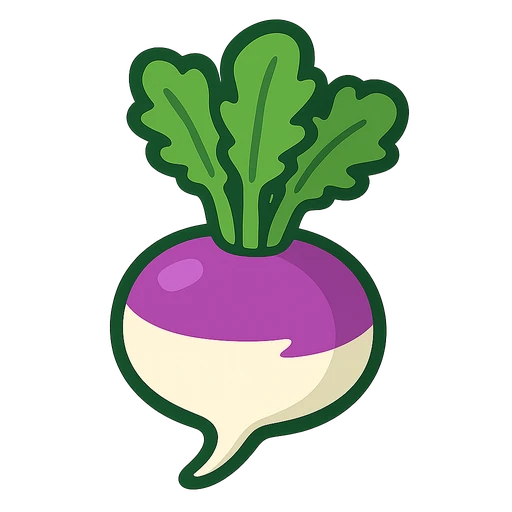
How to grow Turnip

A fast cool-season root that yields twice: peppery greens inside a month, then a crisp globe a few weeks later.

Brassica rapa subsp. rapa · also called Salad turnip, Summer turnip

Full sun Beginner Frost-hardy
Sun
Full sun
Accepts afternoon shade where days stay above 85 °F (29 °C)
Frost
Hardy
Tops take frost to about 20 °F (-7 °C)
Spacing
4 in
10 cm between plants
Sow depth
½ in
13 mm
To harvest
35–60 days
counted from sowing
Timing

When to plant Turnip

Windows are counted from the average date of your last spring frost.

Summer:late summer, 8–10 weeks before first fall frost, for the sweetest roots.
Fall planting:early fall in mild-winter areas for winter greens and small roots.
Too late?Skip a spring sowing once days regularly top 75 °F (24 °C) — roots turn woody and sharp. Sow again 8–10 weeks before first fall frost.
Background

Why grow Turnip

Few crops turn a bare patch of cool soil into food faster, and the roots hold in the ground into hard frost. Both the root and the leaves are eaten, so a short row feeds you twice from one sowing.

A little history. Turnip is a biennial: the swollen root is a first-year food store, spent on flowers the second year. Cold weather converts part of that stored starch to sugar, so fall-grown roots taste sweeter.

The season, step by step

From planting to harvest

Sow outside

2–4 weeks before last frost

Sow seeds ½ inch (13 mm) deep, and aim for 4 inches (10 cm) between plants once thinned. Cover seed lightly and keep the top half-inch moist until sprouts show. Break any crust with a fine spray after hard rain. Seedlings emerge in 3–10 days.

Best soil temp 60–75 °F (16–24 °C) Minimum 40 °F (4 °C) Emerges in 3–10 days

Water and feed

All season

Steady water, twice a week in warm weather; never let the bed swing wet to bone dry. Water when the top inch of soil feels dry. Aim for about 1 inch per week including rain.

Work compost in before sowing; side-dress once at 3–4 weeks if leaves look pale. What to use: compost plus a low-nitrogen blend such as 5–10-10; heavy nitrogen builds tops, not roots.

Prune and maintain

As it grows

Pick only two or three outer leaves per plant if you want greens and a root; stripping the tops stalls root growth.

Harvest and store

35–60 days from sowing

It's ready when roots 2–3 in across, shoulders standing just above soil and smooth to the touch. Greens are ready at 4–6 in tall. Grip the base of the leaves and pull straight up, easing the soil with a hand fork in dry ground. For greens only, cut outer leaves an inch above the crown and let the center regrow.

Twist off tops to a half-inch stub, then store unwashed roots in a perforated bag in the crisper for 3–4 months. Use greens within 3 days.

Companions

Good neighbours, bad neighbours

Plant it with

Garden Pea

Peas bank nitrogen in root nodules, and most of it reaches the soil the following season as those roots break down. Follow a spring pea patch with turnips, or grow peas nearby and leave the roots in the ground when you clear the vines.

Nasturtium

Aphids and flea beetles often settle on nasturtium foliage in preference to turnip leaves. It only helps if you check the trap plants weekly and cut off or wash down the colonized shoots before they spill over.

Dill

Dill's flat flower heads feed hoverflies, lacewings, and tiny parasitic wasps, all of which hunt the aphids and caterpillars that work turnip tops. Let a few plants flower at the bed edge rather than cutting every stem for the kitchen.

Sweet Alyssum

A low ribbon of alyssum blooms through the cool season and is one of the most reliable hoverfly feeders in a vegetable bed; hoverfly larvae eat aphids off turnip leaves. Tuck it along the row where it will not shade the crop.

Lettuce

Lettuce roots stay in the top few inches while the turnip swells deeper, so the two share a bed without fighting for water. Both like the same cool weather, which makes them easy to sow and clear on the same schedule.
Thyme

Strongly scented low herbs can make it harder for cabbage butterflies and flea beetles to home in on turnip leaves by smell. The effect is modest under heavy pest pressure, so treat it as a supplement to row cover, not a replacement.
Keep it away from

Radish

Both are fast root crops filling the same few inches of soil, so interplanted rows crowd each other and neither root sizes up cleanly. They also share flea beetles and root maggots, which stacks pressure in one spot. Grow them in separate blocks under separate covers.

Fennel

Fennel roots release compounds that stunt most garden vegetables, turnip seedlings included. Grown well away in its own corner it earns space, since the flowers feed hoverflies and tiny parasitic wasps that patrol the vegetable beds.

Strawberry

Old charts keep strawberries and cabbage-family crops apart, and no mechanism has been demonstrated. The practical reason to separate them is different: pulling turnips disturbs shallow strawberry roots and runners.

See Turnip in the full companion chart →

Crop rotation

After this crop

Family rest

Give the cabbage family 4 years away from this spot before any of its relatives return.

Good next crops

The tomato family, the pea and bean family or the carrot family thrive in this ground next season.

A heavy feeder that leaves the soil looser than it found it as the roots come out. Keep cabbage-family crops out of this bed for 4 years; follow with the tomato family, with peas or beans, or with carrot-family crops such as carrots and parsley.

Trouble to watch for

Pests and diseases

Pests

Flea beetle

Sign
Tiny black beetles jump when disturbed; leaves peppered with small round shot-holes, worst on seedlings.
Fix
Cover the row with insect netting from the day you sow and keep it on until plants have 6 true leaves.

Cabbage root maggot

Sign
Plants wilt in midday and pull up easily; roots tunneled with brown slime trails and white legless maggots.
Fix
Float row cover over the bed at sowing, sealed at the soil line. Delay spring sowing or move to fall planting.

Cabbage aphid

Sign
Grey-green waxy clusters packed into leaf folds and growing tips; leaves curl and turn sticky.
Fix
Blast colonies off with a hose, then spray remaining clusters with insecticidal soap, hitting leaf undersides.

Imported cabbageworm

Sign
White butterflies over the bed; velvety green caterpillars chewing ragged holes, dark pellets on leaves.
Fix
Hand-pick caterpillars twice a week, or spray a Bt product labeled for caterpillars on the leaves.

Diseases

Clubroot

Sign
Stunted plants that wilt in sun; roots swollen into knobby distorted clubs instead of a clean globe.
Prevent
Test soil first; lime only if the test calls for it, since lime suppresses rather than removes it. Do not replant cabbage-family crops here for years.

Alternaria leaf spot

Sign
Dark round spots on leaves with faint concentric rings and a yellow halo; older leaves collapse first.
Prevent
Space for airflow, water at soil level in the morning, and clear infected leaves rather than tilling them under.

Downy mildew

Sign
Pale yellow blotches on upper leaves with grey-purple fuzz on the underside in cool, damp weather.
Prevent
Thin to full spacing, avoid overhead watering late in the day, and harvest greens promptly in wet spells.

Black rot

Sign
Yellow V-shaped wedges spreading in from leaf edges, veins darkening to black; foliage dries out.
Prevent
Buy clean seed, stay out of the bed while leaves are wet, and remove and bag affected plants.
FAQ

Common questions about Turnip

When should I plant Turnip?
Spring: 2–4 weeks before last frost, as soon as soil can be raked. Summer: late summer, 8–10 weeks before first fall frost, for the sweetest roots.
How long until Turnip is ready to harvest?
35–60 days, counted from sowing. It's ready when roots 2–3 in across, shoulders standing just above soil and smooth to the touch. Greens are ready at 4–6 in tall.
Can I grow Turnip in a container?
Either works — needs 10–12 in of loose, stone-free soil so roots can swell evenly. In containers: 12 in wide, 10 in deep; wider is better than deeper.
How often should I water Turnip?
Steady water, twice a week in warm weather; never let the bed swing wet to bone dry. Water when the top inch of soil feels dry.
How should I store Turnip after harvest?
Twist off tops to a half-inch stub, then store unwashed roots in a perforated bag in the crisper for 3–4 months. Use greens within 3 days.
Can Turnip stay in the ground over winter?
In mild winters, leave roots in place under 6 in of straw and lift as needed. Plants left over winter flower and set seed the second spring.

Verdie turns this guide into your plan

Set your garden's location and every window above becomes a real date — then Verdie reminds you when it's time to sow, transplant, water, and pick.

Download on the App Store
Free to download · iPhone & iPad