Start seeds indoors
Sow shallowly at ¼ inch; keep the seedbed evenly moist — seeds are slow and will fail if the surface dries out between waterings. Seedlings emerge in 14–28 days in warm soil.
A cluster-rooted perennial grown as an annual for its sweet, starchy white roots — a largely forgotten vegetable with genuine garden merit.
Sium sisarum · also called crummock, chervin
Windows are counted from the average date of your last spring frost.
Skirret produces a bundle of slender, sweet roots with a flavor closer to parsnip than carrot, and tolerates heavier, moister soils where carrots struggle. It is rarely available in shops, making home growing the only practical route to the table.
A little history. Native to eastern Asia and documented in European cultivation since at least the 16th century per Dodoens and Gerard. Produces a cluster of 6-12 pencil-thick storage roots from a single crown rather than one taproot.
Sow shallowly at ¼ inch; keep the seedbed evenly moist — seeds are slow and will fail if the surface dries out between waterings. Seedlings emerge in 14–28 days in warm soil.
Sow seeds ¼ inch (6 mm) deep.
Beds strongly preferred; roots reach 8–12 inches and spread as a cluster — containers restrict yield significantly. In containers: 15-gallon half-barrel, minimum 14 inches deep. Space plants 12 inches (30 cm) apart.
Water deeply twice a week during active growth; skirret tolerates moist soil better than most root crops. Water when the top 2 inches of soil feel dry, or leaves show slight midday wilt. Aim for about 1–1.5 inches per week including rain.
Side-dress (scatter fertilizer along the row and water in) once at planting and again 6 weeks later. What to use: low-nitrogen balanced fertilizer or well-rotted compost; excess nitrogen drives leafy growth at the expense of roots.
Pinch out any flower stalks as soon as they appear — allowing the plant to bolt (shift from root growth to flowering) diverts energy from the roots and reduces yield significantly.
It's ready when roots are harvest-ready when the foliage begins to die back in autumn, or once roots reach finger thickness (roughly ¾ inch diameter). Do not wait until roots become woody. Loosen the soil 6–8 inches out from the crown with a fork, then lift the whole cluster by the crown. Separate individual roots by hand. Leave the crown in the ground to overwinter if you want a second-year harvest.
Trim tops to 1 inch, brush off soil, and store unwashed in barely damp sand or peat in a cool (32–40 °F (0–4 °C)), dark place for up to 3 months. Do not refrigerate in plastic — roots rot quickly without airflow.
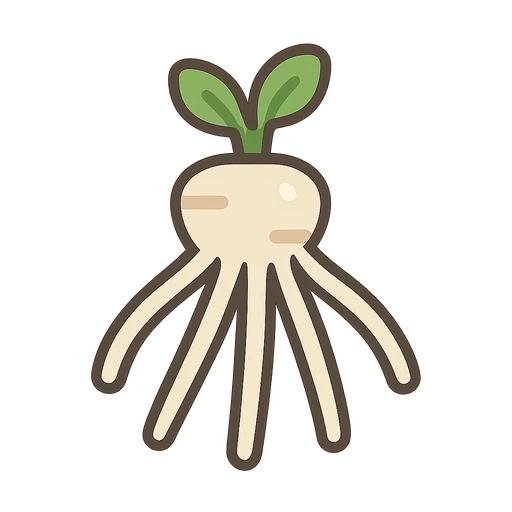
A single spring sowing is usually sufficient; for a continuous supply, divide and replant overwintered crowns in early spring rather than sowing fresh seed each year.
Crowns left in the ground survive hard frost and can be divided in early spring to produce new plants. Mulch with 3–4 inches of straw after the first hard frost to ease spring lifting.
Onion
Onion leaves carry a strong smell that can help hide skirret's carrot-family scent from carrot fly females hunting for a place to lay eggs. The effect shows up mainly under low pest pressure and stops once the onions are pulled.
Leek
Leeks hold their ground beside skirret for the whole season, so their onion smell keeps working late into autumn when carrot fly is still active. Useful backup where insect mesh is awkward, though mesh remains the reliable control.
Lettuce
Lettuce feeds in the top few inches while skirret's root cluster works 8-12 inches down, so the two rarely fight over water. Lettuce is also cut and gone well before the roots do their main bulking.
Spinach
Sown between the rows, spinach covers bare ground during the two to four weeks skirret seed takes to emerge, holding surface moisture and crowding out weeds. Clear it once it starts shading the young crowns.
Parsnip
Parsnip shares skirret's family and its troubles: carrot fly, and the soil-borne root rots that linger for years. Growing them in one bed stacks the pressure and leaves you nowhere clean to move either crop.
Carrot
Carrot and skirret feed the same carrot fly generations and host the same root rots, so a mixed bed lets pest and spore numbers build through the season. Keep them in separate beds and mesh each one.
Celery
Celery is another carrot-family crop that shares leaf blights and carrot fly with skirret, and its constant thirst draws on the same moist soil the roots need. Grow it in a different bed.
A perennial — it holds its spot for years, so it sits outside the annual rotation.
Skirret sits outside the annual rotation: crowns hold a bed for several seasons, take a moderate feed, and leave soil loosened deep down. No fixed family gap applies. When you finally clear the bed, dig out every root piece, then follow with peas or beans and a leafy crop.