Transplant outside
Beds strongly preferred — deep, rich soil and permanent placement suit this long-lived perennial best. In containers: 15-gallon pot, minimum 18 inches deep. Space plants 36 inches (90 cm) apart.
A long-lived perennial that delivers tart, celery-like stalks every spring for a decade or more with minimal annual effort.
Rheum rhabarbarum · also called pie plant, wine plant
As soon as soil can be worked, 4–6 weeks before last frost.
6–8 weeks before first hard frost, so roots establish before freeze.
Once established, a single crown produces generous harvests year after year with little more than mulch and a spring feed. The stalks freeze exceptionally well, extending the harvest well past the short picking window.
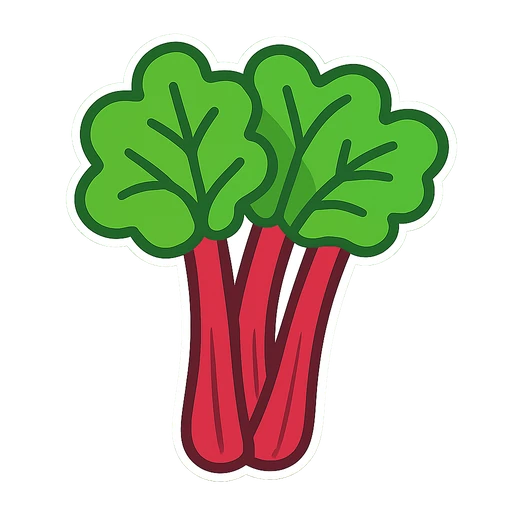
A little history. Native to Siberia and central Asia, rhubarb is a cool-season perennial grown as a vegetable; only the stalks are eaten. The large leaves contain high concentrations of oxalic acid and are toxic to humans and livestock.
Beds strongly preferred — deep, rich soil and permanent placement suit this long-lived perennial best. In containers: 15-gallon pot, minimum 18 inches deep. Space plants 36 inches (90 cm) apart.
Deep soak once or twice a week during active spring growth; reduce once stalks slow in summer heat. Water when the top 2 inches of soil feel dry to the touch. Aim for about 1 inch per week including rain.
Side-dress (scatter fertilizer along the row and water in) once in early spring as shoots emerge, and again after the final harvest. What to use: balanced compost or a 10–10-10 granular fertilizer; rhubarb is a heavy feeder.
Remove flower stalks (the thick, round stems topped with a large seed head) as soon as they appear — allowing them to develop diverts energy from stalk production and can reduce the following year's yield.
It's ready when stalks are 10–15 inches long and at least ¾ inch thick; color (red or green depending on variety) is fully developed. Do not harvest in the first year; take no more than one-third of stalks in year two. Grasp each stalk near the base and pull with a firm downward twist to detach cleanly from the crown. Cut off and discard the leaf blade immediately — do not compost rhubarb leaves.
Wrap unwashed stalks loosely in a damp cloth or plastic bag and refrigerate for up to 2 weeks. Stalks freeze well: chop, blanch 1 minute, cool, and freeze in airtight bags for up to 12 months.
Cut back dead foliage after hard frost kills it. Mulch crowns with 3–4 inches of straw or shredded leaves in cold climates to moderate freeze-thaw cycles; remove mulch as shoots emerge in spring.
Strawberry
Both are permanent plantings that dislike annual digging, and their roots work different layers — strawberry runners feed in the top few inches while rhubarb's thick storage roots pull from well below, so they can often share a rich bed edge without fighting for water.
Garlic
The strong smell of garlic foliage can help hide young rhubarb shoots from pests that locate plants by scent, and garlic finishes in midsummer without shading the crown.
Onion
Gardeners have long tucked onions along the sunny front edge of a rhubarb bed. No mechanism has been demonstrated, but onions are shallow-rooted and short-season, so they take little from the crown.
Kale
Old charts keep rhubarb near the cabbage family, and kale is said to benefit from the pairing. Nothing is proven, so give kale its own open ground several feet out where the big rhubarb leaves will not shade it.
Cabbage
Cabbage is another long-standing chart neighbour for rhubarb. Treat it as tradition rather than protection, and site heads outside the crown's leaf spread so both get full light.
Dock weeds are the breeding host for rhubarb curculio — the beetle lays eggs in dock stems, and the adults move onto nearby rhubarb stalks. Clearing dock from the surrounding ground is the standard control.
Sunflower
Sunflowers out-muscle a rhubarb crown for water and light and throw heavy shade across it in midsummer; their roots and spent stems also release compounds that can stunt neighbours. Keep them well clear of a permanent rhubarb bed.
Oca
Rhubarb's broad leaves and permanent crown shade and out-muscle oca just as it needs autumn light to bulk up tubers, and digging oca each year disturbs rhubarb's roots. Give each its own bed.
A perennial — it holds its spot for years, so it sits outside the annual rotation.
Rhubarb is a permanent planting and sits outside the annual rotation — no family gap applies. It feeds moderately and leaves behind deep, compost-enriched ground. If you finally lift and move a crown, that spot suits hungry leafy greens or the cabbage family next.