
Crop guide · The pea and bean family

How to grow Hairy Vetch

A winter-hardy climbing legume that covers bare beds through the cold months and hands back a large nitrogen supply when cut down in spring.

Vicia villosa · also called Winter vetch, Sand vetch

Full sun Beginner Frost-hardy
Sun
Full sun
Tolerates part shade under bare fruit trees in winter, but growth is thinner
Frost
Hardy
Well-rooted plants survive hard freeze and snow cover. Seedlings under 3 in tall are the ones that winterkill.
Spacing
2 in
5 cm between plants
Sow depth
¾ in
19 mm
To harvest
180–240 days
counted from sowing
Timing

When to plant Hairy Vetch

Fall
Direct sow

30–45 days before the first hard frost, so plants reach 4–6 in tall.

Summer
Direct sow

Late summer, right after pulling a finished summer crop.

Spring
Direct sow

As soon as soil can be raked, for a short 60-day green manure.

Too late?Sow at least 30 days before the first hard frost. Later stands go into winter too small and often die back.
Background

Why grow Hairy Vetch

One fall sowing protects soil from winter rain, smothers early weeds, and banks nitrogen in its roots and stems for the crops that follow. Few cover crops give more spring biomass in a home bed.

A little history. A winter annual legume native to Europe and western Asia. Bacteria living in nodules on its roots take nitrogen from air spaces in the soil and convert it into a form plants can absorb.

The season, step by step

From planting to harvest

Sow outside

30-45 days before the first hard frost, so plants reach 4-6 in tall

Sow seeds ¾ inch (19 mm) deep, and aim for 2 inches (5 cm) between plants once thinned. Rake seed under ½ to 1 in of soil, tamp firmly, and keep the surface damp until sprouts show. Uncovered seed on crusted ground fails. Seedlings emerge in 7–14 days.

Best soil temp 60–70 °F (16–21 °C) Minimum 45 °F (7 °C) Emerges in 7–14 days

Water and feed

All season

Water at sowing and every few days until seedlings are 3 in tall, then rely on rain. Water when water if the top inch is dry during the first three weeks. Aim for about 1 inch per week while establishing.

No nitrogen at any point; add phosphorus or potassium only if a soil test is low. What to use: coat seed with pea and bean inoculant powder before sowing instead of fertilizer.

Prune and maintain

As it grows

Mow or shear tall spring growth back to 4 in if vines start climbing into neighboring plants. Leave the clippings on the surface as mulch.

Harvest and store

180–240 days from sowing

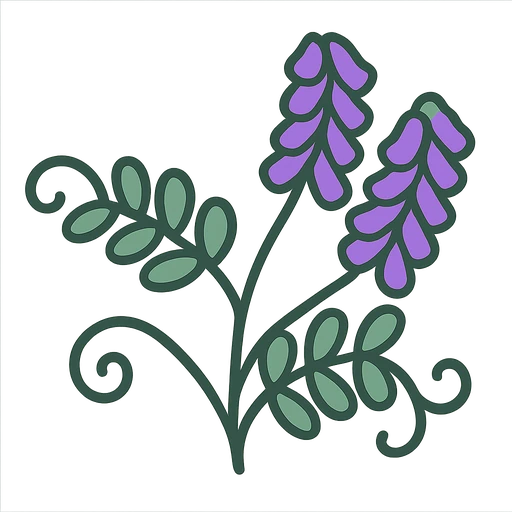
It's ready when terminate when the first purple flower spikes open, usually mid to late spring. That is the point of most nitrogen with residue that still breaks down quickly. Cut or mow at the soil line, or crimp vines flat with a board. Either leave the mat as mulch and plant transplants through it, or turn the top 4 in of soil and wait 2–3 weeks before sowing seed.

Not a food crop. Keep leftover seed in a sealed jar in a cool, dry, dark place; it stays sound for about five years.

Companions

Good neighbours, bad neighbours

Plant it with

Rye

Rye stems hold vetch vines up off wet winter soil so growth stays open and dry, while the vetch banks nitrogen that helps break down rye's tough straw the following season. Sow the two together at about half rate each.

Oats

Oats grow fast in fall and give young vetch something to climb before cold sets in. Oats usually winterkill and collapse into mulch, leaving the hardier vetch standing with a ready-made frame.

Wheat

Wheat's stiff stems lift vetch vines into the light, and the mix produces more total growth than either sown alone. The nitrogen the vetch stores is released as roots break down for next season's crop.
Barley

Barley establishes quickly and gives the climbing vetch support through winter; the pairing covers bare ground faster than vetch on its own, which cuts weed germination in the bed.
Spelt

Spelt's tall stems carry vetch tendrils upward instead of letting them mat on the ground. Mow both at vetch's first bloom so the coarse grain straw and soft vetch tops break down together.

Emmer

Emmer gives the vines a sturdy ladder over winter, and the vetch adds nitrogen to a mix that is otherwise all carbon, so the residue rots down faster after mowing.
Einkorn

Einkorn's fine stems are enough to hold vetch off the soil surface in a small bed. Sow them mixed rather than in separate rows so the tendrils find support within a few inches.

Tomato

Mowed hairy vetch left on the surface has been shown to work well as a planting mulch for tomatoes: it holds soil moisture, keeps splashing soil off lower leaves, and supplies nitrogen as it breaks down. Set transplants through slits in the mat.

Keep it away from

Fennel

Fennel's roots release compounds that reliably stunt most garden plants, and vetch seedlings are small and slow enough to suffer badly. Grow fennel in its own corner, where its flowers can still feed hoverflies and tiny parasitic wasps.

Asparagus

Vetch twines onto anything nearby and drops hard seed that sprouts for years, so it can tangle a permanent asparagus row and make spear cutting awkward. Keep it in annual beds you will mow and turn.

Onion

Old companion charts have long kept the onion family away from peas, beans, and vetch. No mechanism has been demonstrated, so treat it as tradition; the practical concern is simply that a vetch mat crowds slender onion tops.

See Hairy Vetch in the full companion chart →

Crop rotation

After this crop

Family rest

Give the pea and bean family 2 years away from this spot before any of its relatives return.

Good next crops

The cabbage family, the beet family or grasses and grains thrive in this ground next season.

A giver: it leaves nitrogen behind in roots and residue, released as that residue breaks down. Follow with hungry cabbage-family crops, beets and chard, or a grain. Wait two years before returning peas, beans, or vetch to this bed.

Trouble to watch for

Pests and diseases

Pests

Pea aphid

Sign
Clusters of small green insects on stem tips in spring, with sticky leaves below.
Fix
Spray affected tips with a strong jet of water, or mow the stand early; ladybugs usually clean up the rest.

Slugs and snails

Sign
Ragged holes in low leaves and slime trails through the dense mat, worst in wet spring weather.
Fix
Mow the stand to open it up and dry the surface before planting seedlings into the residue.

Deer and rabbits

Sign
Grazed patches with stems bitten off cleanly a few inches above the soil.
Fix
Fence or net winter stands in areas with heavy browsing; light grazing does not kill the crop.

Vetch weevil

Sign
Small round exit holes in saved seed, and adults notching leaf edges.
Fix
Buy fresh seed rather than saving it, and freeze any home-saved seed for one week before storage.

Diseases

Root and seedling rot

Sign
Patchy stands, seedlings that flop over with brown, pinched stems at the soil line.
Prevent
Sow into well-drained soil that has dried after rain, and avoid burying seed deeper than 1 inch.

Powdery mildew

Sign
White dusty film on upper leaves in late spring, oldest leaves yellowing first.
Prevent
Sow at the recommended thin rate for airflow and mow the stand at first bloom before mildew builds.

White mold

Sign
Water-soaked stems near the ground with cottony white growth and hard black pellets inside.
Prevent
Do not follow a bean, pea, or lettuce crop that had white mold; mow and turn residue under promptly.

Downy mildew

Sign
Pale blotches on leaf tops with grayish fuzz on the undersides during long cool damp spells.
Prevent
Keep stands out of low spots that stay wet, and terminate the crop on time rather than letting it mat.
Good to know:Not a food crop. Seeds and foliage are not eaten by people, and large amounts can sicken grazing livestock — keep horses and cattle off dense stands.
FAQ

Common questions about Hairy Vetch

When should I plant Hairy Vetch?
Fall: 30–45 days before the first hard frost, so plants reach 4–6 in tall. Summer: late summer, right after pulling a finished summer crop.
How long until Hairy Vetch is ready to harvest?
180–240 days, counted from sowing. It's ready when terminate when the first purple flower spikes open, usually mid to late spring. That is the point of most nitrogen with residue that still breaks down quickly.
Can I grow Hairy Vetch in a container?
Beds and open ground only — needs area, not a pot. Works well in unused raised beds over winter.
How often should I water Hairy Vetch?
Water at sowing and every few days until seedlings are 3 in tall, then rely on rain. Water when water if the top inch is dry during the first three weeks.
Is any part of Hairy Vetch unsafe to eat?
Not a food crop. Seeds and foliage are not eaten by people, and large amounts can sicken grazing livestock — keep horses and cattle off dense stands.
How should I store Hairy Vetch after harvest?
Not a food crop. Keep leftover seed in a sealed jar in a cool, dry, dark place; it stays sound for about five years.

Verdie turns this guide into your plan

Set your garden's location and every window above becomes a real date — then Verdie reminds you when it's time to sow, transplant, water, and pick.

Download on the App Store
Free to download · iPhone & iPad