Transplant outside
Beds strongly preferred; deep, spreading roots make long-term container culture difficult and reduces yield significantly. In containers: 25-gallon container minimum; yields will be limited. Space plants 60 inches (150 cm) apart.
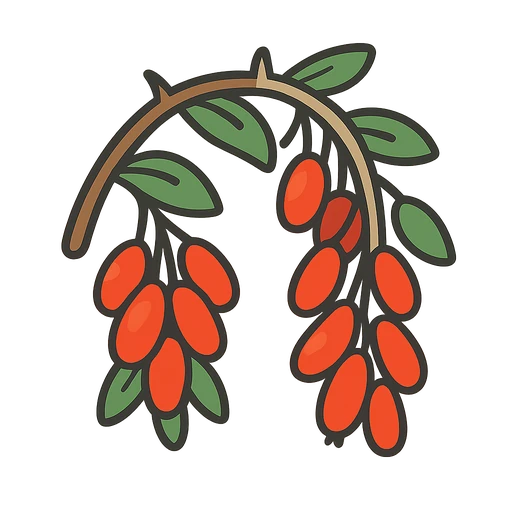
A hardy, long-lived shrub that produces small, sweet-tart red berries over a remarkably long season with minimal inputs once established.
Lycium barbarum · also called wolfberry, Chinese wolfberry
After last frost, once soil has warmed to at least 50 °F (10 °C).
6–8 weeks before first expected frost to allow root establishment.
Goji produces fruit for decades from a single planting and tolerates drought, poor soil, and hard frost that would kill most fruiting shrubs. The fresh berries, rarely available commercially, have a flavor distinct from the dried product.
A little history. Native to temperate regions of China and widely naturalized elsewhere; a deciduous shrub in the nightshade family, bearing arching canes that can reach 8-10 feet if unpruned. Documented in Chinese agricultural records for over a millennium.
Beds strongly preferred; deep, spreading roots make long-term container culture difficult and reduces yield significantly. In containers: 25-gallon container minimum; yields will be limited. Space plants 60 inches (150 cm) apart.
Water deeply once or twice a week during the first season; established plants need water only during prolonged dry spells. Water when the top 2 inches of soil feel dry during the establishment year. Aim for about 1 inch per week in year one; less once established.
Side-dress (scatter fertilizer along the drip line and water in) once in early spring and once after the first flush of fruit. What to use: balanced compost or low-nitrogen organic fertilizer; excess nitrogen favors cane growth over fruit.
In late winter before bud break, remove dead or crossing canes and cut back the previous year's laterals (side shoots) to 2–3 buds. Pinch shoot tips in the first year to encourage branching. Fruit forms on second-year wood.
It's ready when berries are fully ripe when uniformly bright orange-red, slightly soft to the touch, and release easily from the stem with a gentle roll between fingers. Cup a cluster in your palm and roll ripe berries off with your thumb — do not pull, as the stems are thorny. Harvest every 2–3 days during peak season; ripe berries drop quickly.
Fresh berries keep 3–5 days refrigerated in a single layer. Dry at 95–115 °F (35–46 °C) until leathery for long-term storage; dried berries keep 12 months in an airtight container.
No action needed for established plants in most climates — they are fully dormant and cold-hardy. In the first winter, mulch the root zone with 3–4 inches of straw to protect young roots from freeze-thaw cycles.
Lavender
Lavender's long bloom brings bees into the planting through the weeks goji is flowering, which often improves fruit set even though goji sets some fruit on its own. It also asks for the same lean soil and dry summers, so watering never conflicts.
Rosemary
A strongly aromatic shrub planted at the edge of the goji row can help confuse aphids that locate new shoot tips by smell. The effect is modest under heavy pressure, but rosemary shares goji's need for full sun and sharp drainage, so it costs nothing to try.
Yarrow
Yarrow's flat flower heads reliably draw in hoverflies, lacewings, and tiny parasitic wasps whose larvae feed on aphids — the pest most likely to colonize goji's soft new canes in spring. Let a clump flower a few feet from the shrub.
Garlic
Garlic's onion scent often reduces aphid landings on nearby soft growth, and its shallow roots and early summer harvest keep it out of the goji's way. Plant it in the open ground beyond the drip line so digging bulbs does not tear surface roots.
Tomato
Goji and tomato are both in the nightshade family and host the same soilborne wilts and leaf diseases. Since the goji bed is permanent, keeping tomatoes out of it and out of the beds beside it stops disease from cycling year after year.
Bell Pepper
Peppers share goji's family and its susceptibility to the same root and stem diseases. A permanent shrub cannot be rotated away from an infected spot, so give peppers their own bed well clear of the goji's root zone.
Potato
Potatoes carry nightshade-family wilts and blights, and digging tubers next to a goji both spreads that soil and tears the shrub's spreading surface roots. Keep at least one bed between them.
A perennial — it holds its spot for years, so it sits outside the annual rotation.
Goji is a permanent planting, so there is no yearly rotation — the bed is spoken for. It is a moderate feeder that leaves behind a dense woody root mass. If the shrub is ever removed, wait 3 years before planting tomatoes, peppers, potatoes, or eggplant in that ground.