Transplant outside
4–6 weeks before last frost
Beds strongly preferred; containers work only with a minimum 15-gallon pot and diligent watering. In containers: 15-gallon pot, at least 18 in deep. Space plants 60 inches (150 cm) apart.
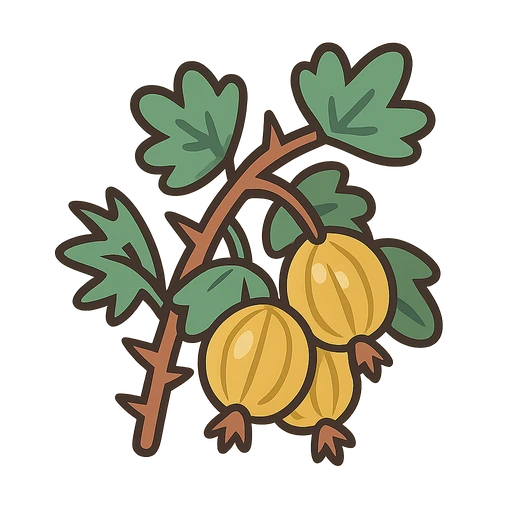
A thorny, long-lived shrub that produces tart-to-sweet berries in early summer with minimal annual care once established.
Ribes uva-crispa · also called European gooseberry, garden gooseberry
After leaves drop, 4–6 weeks before ground freezes — bare-root stock establishes best.
As soon as soil is workable, before buds break — typically 4–6 weeks before last frost.
Gooseberries crop reliably in cool climates where many soft fruits struggle, tolerate partial shade better than most fruiting shrubs, and a single established plant can yield 8-10 pounds of fruit per season for decades.
A little history. Native to the Caucasus and western Europe, Ribes uva-crispa is a deciduous shrub in the Grossulariaceae family. Flower buds are set the previous season, so late-spring frosts can reduce yield without killing the plant.
Beds strongly preferred; containers work only with a minimum 15-gallon pot and diligent watering. In containers: 15-gallon pot, at least 18 in deep. Space plants 60 inches (150 cm) apart.
Deep soak once a week during dry spells; increase to twice weekly when fruit is swelling in early summer. Water when the top 2 inches of soil feel dry, or leaves begin to look slightly dull. Aim for about 1 inch per week including rain.
Apply once in early spring as buds swell; side-dress (scatter fertilizer along the drip line and water in) a second time after harvest. What to use: balanced 10–10-10 or compost top-dress; avoid excess nitrogen, which promotes soft growth prone to mildew.
In late winter, remove stems older than 3 years at the base and any crossing or inward-facing branches. Aim for 8–10 well-spaced stems of mixed ages. Tip-prune (cut back the leading shoot by one-third) new growth to encourage fruiting spurs.
It's ready when berries are full-sized and yield slightly to gentle pressure. For cooking, pick when still firm and just underripe (late June). For fresh eating, wait until fully colored and soft. Wear gloves to protect against thorns. Strip the whole cluster or pick individual berries by rolling each one off between thumb and forefinger. Harvest over 2–3 weeks as berries ripen unevenly.
Refrigerate unwashed in a shallow container for up to 2 weeks. Freeze on a tray then bag for up to 12 months. Ripe berries do not hold long at room temperature.
No action needed for established plants in most climates — they are fully dormant and cold-hardy. In the first winter after planting, mulch the root zone with 3 inches of straw to protect against frost heave.
 Garlic
Gardeners have long tucked garlic under fruit bushes on the idea that its sharp smell hides the shrub from aphids and other pests that hunt by scent. Evidence in fruit plantings is thin, but garlic takes little room at the drip line and does no harm.
 Chives
A ring of chives around the bush can help confuse aphids searching for new shoots by smell, and under low pest pressure that is often enough to keep colonies small. Keep the clump 18 inches out so it does not compete with feeder roots.
 Tomato
Old cottage-garden charts keep tomatoes beside gooseberries and credit the strong-smelling foliage with putting off gooseberry sawfly. No trial supports it, so treat it as harmless tradition and give the tomato full sun of its own rather than the shrub's shade.
 Fava Bean
Fava beans bank nitrogen in root nodules that is mostly released the following season as the roots break down, so a row cut off at soil level near the bush feeds next year's growth. Their early flowers also bring bumblebees past the gooseberry bloom.
 Fennel
Fennel roots release substances that stunt most garden plants, including young fruit bushes still building a root system. Plant it in its own corner well away from the shrub, where its flat flower heads still feed hoverflies and tiny parasitic wasps that hunt aphids.
 Pinon
Pinon
Like currants, gooseberries carry the summer stage of white pine blister rust, and infections on a pine trunk cannot be cured. Plant them well away, or skip them entirely on a pinon site.
 Korean Pine
Gooseberry is the same alternate host as currant for white pine blister rust, which spreads from its leaves to nearby pine bark and forms girdling cankers. Some regions still restrict planting it near pines for this reason.
A perennial — it holds its spot for years, so it sits outside the annual rotation.
A perennial shrub, so no rotation applies and no family gap is needed for neighbouring crops. It leaves a permanent, lightly fed root zone behind. If mildew or leaf spot was severe, wait about 5 years before setting a new currant or gooseberry in the same hole.
Set your garden's location and every window above becomes a real date — then Verdie reminds you when it's time to sow, transplant, water, and pick.