Start seeds indoors
Sow 0.25–0.5 inches deep; keep the seedbed evenly moist until sprouts emerge — do not let the surface crust over. Seedlings emerge in 5–10 days in warm soil.
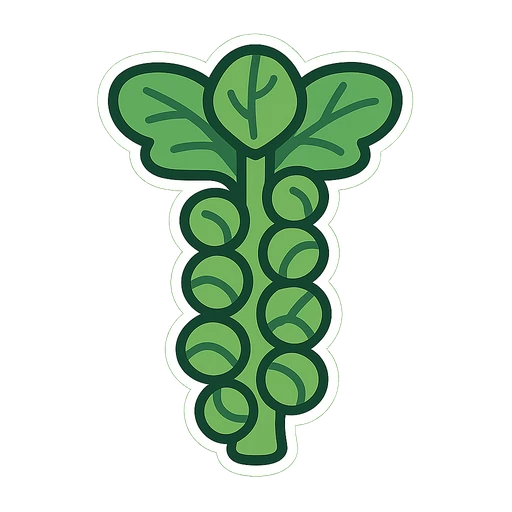
A slow-maturing cool-season crop that produces dense, cabbage-like buds along a tall central stalk, sweetening noticeably after autumn frost.
Brassica oleracea var. gemmifera · also called sprouts, mini cabbages
6–8 weeks before last frost for a fall harvest.
12–14 weeks before first autumn frost for best flavor.
Home-grown sprouts harvested after frost have a sweeter, less sulfurous flavor than supermarket equivalents because cold temperatures convert stored starches to sugars in the developing buds. A single planting in spring or early summer yields harvests from autumn through early winter.
A little history. Brussels sprouts are a cultivated form of wild cabbage, selected over centuries for enlarged axillary buds (the buds that form in the angle between leaf and stem). Each bud is a compressed, miniature head. The crop is documented in Belgian cultivation records from the 13th century.
Sow 0.25–0.5 inches deep; keep the seedbed evenly moist until sprouts emerge — do not let the surface crust over. Seedlings emerge in 5–10 days in warm soil.
Sow seeds ½ inch (13 mm) deep.
Beds strongly preferred — deep, rich soil supports the tall stalk; containers require at least 15 gallons and 18 inches of depth. In containers: 15-gallon pot, minimum 18 inches deep. Space plants 24 inches (60 cm) apart.
Deep soak twice a week; increase to every other day during dry spells above 80 °F (27 °C). Water when the top 2 inches of soil feel dry, or leaves show slight midday droop. Aim for about 1–1.5 inches per week including rain.
Side-dress (scatter fertilizer along the row and water in) at transplant, then again 4 weeks later and when buds begin to form. What to use: nitrogen-forward balanced fertilizer such as 10–5-5 or a high-nitrogen compost; reduce nitrogen once buds set.
When lower buds reach marble size, snap off the leaves below them to improve air circulation. About 3–4 weeks before your first frost, pinch out (remove by hand) the growing tip at the top of the stalk to redirect energy into sizing up the remaining buds.
It's ready when buds are firm, tightly closed, and 1–1.5 inches across. Start at the base of the stalk — lower buds mature first. Loose, open, or yellowing buds are past their peak. Twist each bud sharply downward and away from the stalk, or cut with a clean knife flush to the stem. Harvest upward progressively as buds reach size; do not strip the whole stalk at once unless a hard freeze is imminent.
Unwashed buds on the stalk keep up to 5 days at 32–35 °F (0–2 °C). Detached buds store 3–5 days refrigerated in a loose bag. Blanch and freeze for up to 12 months.
A single sowing is typical — the long growing season leaves little room for succession. In mild-winter climates, a second transplanting 3 weeks after the first extends harvest into late winter.
Nasturtium
Cabbage aphids and cabbage white caterpillars often settle on nasturtium leaves before they find the sprout stalk. Plant it a few feet off to the side and pull or spray the infested foliage — a trap crop only works if you remove the pests it collects.
Dill
Let dill flower and its flat umbels feed hoverflies, lacewings, and tiny parasitic wasps that hunt cabbage aphids and caterpillars. Under low pest pressure this often keeps aphid colonies from building up on the lower leaves.
Celery
Gardeners have long set celery beside cabbage-family crops, and the two are said to shelter one another from cabbage white butterflies. No mechanism has been demonstrated, but both want rich, steadily moist soil, so they are easy bedfellows.
Onion
The sharp smell of onion foliage can help hide the cabbage scent that root flies and cabbage whites track, and trials show reduced landings in mixed plantings. Keep onions at the bed edge so their shallow roots do not compete with the sprout stalk.
French Marigold
French marigold flowers feed hoverflies and small parasitic wasps that work the sprout leaves for aphids. Its root-knot nematode suppression is real but only when it is sown thickly as a block and dug into the soil at season's end — a few edge plants will not do it.
Strawberry
Old charts keep strawberries and the cabbage family apart, and no mechanism has ever been shown. The practical objection is simpler: sprouts hold a bed for most of a year, and harvesting or renewing a strawberry patch underneath them is awkward.
Tomato
Both are heavy feeders that draw hard on nitrogen, and a caged tomato often shades the lower half of the stalk where the first buds should be sizing up. Give them separate beds so neither is starved or shaded at the wrong moment.
Give the cabbage family 4 years away from this spot before any of its relatives return.
The tomato family, the pea and bean family or the carrot family thrive in this ground next season.
Sprouts are heavy feeders and leave the bed hungry, with a long-lived stalk and root mass to clear. Keep all cabbage-family crops out for 4 years. Follow with the tomato family, with peas or beans to rebuild nitrogen for the season after, or with carrots and their relatives.