Start seeds indoors
Sow ¼ inch deep; keep the medium evenly moist but not waterlogged until sprouts appear — seeds rot if left sitting in standing water. Seedlings emerge in 10–21 days in warm soil.
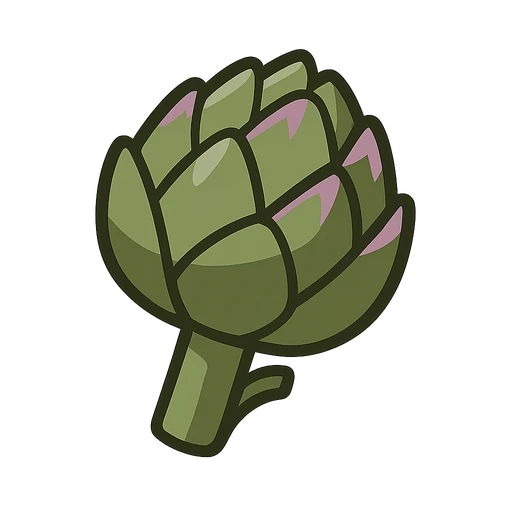
A bold, architectural perennial thistle grown for its tender, edible flower buds — harvested before the purple blooms open.
Cynara cardunculus var. scolymus · also called Globe artichoke, French artichoke
Windows are counted from the average date of your last spring frost.
Home-grown buds are noticeably sweeter and more tender than store-bought because they go from plant to pot within hours. The silvery foliage also earns its place as a structural garden specimen even when not in harvest.
A little history. Native to the Mediterranean basin; the cultivated artichoke is a selected form of the wild cardoon. It is a true perennial in frost-free climates, dying back and resprouting from the crown in cooler regions.
Sow ¼ inch deep; keep the medium evenly moist but not waterlogged until sprouts appear — seeds rot if left sitting in standing water. Seedlings emerge in 10–21 days in warm soil.
Beds strongly preferred — plants reach 4–6 ft wide and need 18–24 inches of rich, well-drained soil; containers are rarely practical. In containers: 25-gallon or larger half-barrel; not recommended long-term. Space plants 48 inches (120 cm) apart.
Deep soak once or twice a week; increase to every 3–4 days during bud development in warm weather. Water when the top 2 inches of soil feel dry, or when outer leaves begin to look slightly dull. Aim for about 1.5–2 inches per week during active growth.
Side-dress (scatter fertilizer along the row and water in) at planting, again when plants reach 12 inches tall, and once more as buds begin to form. What to use: high-nitrogen organic fertilizer or well-aged compost; reduce nitrogen once buds set to avoid soft, loose heads.
Remove all but 2–3 of the strongest shoots per crown each spring to concentrate energy into large buds. After the main terminal bud is harvested, cut the stem back to the next lateral (side shoot) to encourage secondary buds.
It's ready when harvest when the central bud is 3–5 inches across, bracts are still tightly closed and deep green, and the bud feels firm and heavy when squeezed gently. Cut the stem 1–2 inches below the bud with a sharp knife or pruners. Harvest the large terminal bud first; smaller lateral buds follow over the next 2–4 weeks. Do not pull or twist.
Refrigerate unwashed buds in a sealed plastic bag with a few drops of water; use within 1 week. Blanched hearts freeze well for up to 6 months.
Not applicable for succession sowing — stagger varieties by maturity date (early vs. mid-season) if a longer harvest window is needed.
In climates with frost: cut plants to 12 inches after the first frost, mound 6–8 inches of straw or dry leaves over the crown, and remove mulch once new growth appears in spring. Crowns reliably resprout where winters stay above 20 °F (-7 °C).
Sunflower
Sunflower's open heads feed hoverflies, lacewings, and tiny parasitic wasps that hunt the aphids that pack between artichoke bracts. Set the sunflowers on the north side so their stalks do not shade the clump.
Tarragon
Gardeners have long tucked tarragon along the edge of artichoke beds. No mechanism has been demonstrated, so treat it as a tidy use of the open ground around a young crown rather than as pest protection.
Garden Pea
Peas bank nitrogen in their roots, and most of it becomes available only as those roots break down — so the benefit reaches the artichoke crown in later seasons, not the current one. Sow them nearby in early spring while the clump is still small, then cut the vines at soil line and leave the roots.
Fava Bean
Fava beans store nitrogen in their roots during cool weather; cut the tops for the compost pile and leave the roots in place, and that nitrogen feeds the artichoke bed as the roots decay over following seasons.
Potato
Harvesting potatoes means forking through soil where an artichoke has already spread thick perennial roots and crown buds, and that disturbance sets the plant back. Keep potatoes in the annual beds you turn over each year.
Tomato
A mature artichoke spreads 4 to 6 feet of heavy silver foliage and shades out whatever sits beside it, while a staked tomato pulls hard on the same water and nitrogen. Both crops finish smaller; give them separate beds.
Salsify
Both belong to the daisy family and share leaf diseases such as powdery mildew, so growing them shoulder to shoulder stacks the risk. The artichoke's broad canopy also shades and out-roots the narrow salsify tops.
A perennial — it holds its spot for years, so it sits outside the annual rotation.
Artichoke holds its bed for four to five years, so no family gap applies while it stands; it is a moderate feeder that leaves behind deep roots and plenty of organic matter once cut down. When you finally clear the crown, follow with peas or beans, or with a root crop.