Crop guide · The pea and bean family (legumes)

How to grow snow peas

A cool-season climber that produces flat, sweet, entirely edible pods — one of the earliest harvests a spring garden can offer.

Pisum sativum var. saccharatum · also called Snap Pea, Chinese Pea

Full sun Beginner Frost-hardy
Sun
Full sun
Provide afternoon shade once temperatures consistently exceed 80 °F (27 °C) to extend the harvest window.
Frost
Hardy
Tolerates light frost down to about 28 °F (-2 °C) once established
Spacing
3 in
8 cm between plants
Sow depth
1 in
25 mm
To harvest
55–70 days
counted from sowing
Soil pH
6.0–7.5
slightly acidic to neutral
Timing

When to plant snow peas

Windows are counted from the average date of your last spring frost.

Fall planting:8–10 weeks before first fall frost.
Too late?Skip spring sowing once daytime temperatures regularly exceed 75 °F (24 °C) — heat collapses pod quality; switch to a fall sowing instead.
Background

Why grow snow peas

Snow peas mature weeks before most vegetables and require almost no processing — pick and eat straight from the vine. Their root bacteria fix atmospheric nitrogen into the soil, leaving the bed richer than they found it.

A little history. Native to the Mediterranean and Near East, snow peas are a pod-type selection in which the inner membrane (the papery lining that makes shell-pea pods tough) remains thin and edible at harvest. Documented in cultivation for over 3,000 years.

The season, step by step

From planting to harvest

Sow outside

4–6 weeks before last frost

Sow seeds 1 inch (25 mm) deep, and aim for 3 inches (8 cm) between plants once thinned. Sow 1 inch deep and keep soil evenly moist; do not let the surface crust over — thin crusting is the most common cause of patchy emergence. Seedlings emerge in 6–14 days.

Best soil temp 55–65 °F (13–18 °C) Minimum 40 °F (4 °C) Emerges in 6–14 days

Water and feed

All season

Water deeply twice a week; increase to every other day once pods begin forming. Water when the top inch of soil feels dry to the touch. Aim for about 1 inch per week including rain.

Apply a low-nitrogen fertilizer once at planting; avoid heavy feeding mid-season. What to use: compost worked into the bed at planting; a side-dress (scatter fertilizer along the row and water in) of balanced 5–5-5 organic at flowering if growth looks pale.

Prune and maintain

As it grows

Pinch out the growing tip once the plant reaches the top of its support to redirect energy into pod production. Remove yellowing lower leaves to improve airflow.

Harvest and store

55–70 days from sowing

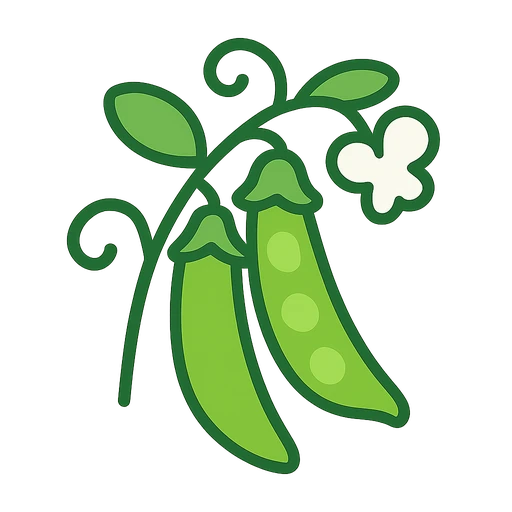
It's ready when pods are flat, bright green, and about 3 inches long with seeds just barely visible as slight bumps; the pod snaps cleanly when bent. Hold the vine steady with one hand and snap or cut each pod off with the other — pulling without support tears the stem. Harvest every 2–3 days once pods begin forming to keep the plant producing.

Refrigerate unwashed in a sealed bag for up to 5 days. For longer storage, blanch 1–2 minutes, cool in ice water, and freeze in a single layer before bagging.

Companions

Good neighbours, bad neighbours

Plant it with

Carrot

Carrots send a single deep taproot well below the pea's fine surface roots, so the two draw water and nutrients from different layers instead of competing. Both also prefer the same cool spring soil, so their timing lines up.
Radish

Radishes swell and finish in about a month, using shallow soil beside the pea row and clearing out long before the vines fill their trellis. Pulling them loosens the surface without disturbing pea roots.

Spearmint

Gardeners have long set mint near peas on the idea that its strong scent throws off aphids hunting by smell; the effect is not well demonstrated. If you try it, sink the mint in a buried pot or a separate container, because it spreads by runners and will overrun a pea bed.
Spinach

A pea trellis throws light shade on the row to its north side, which can hold spinach in leaf a week or two longer before late-spring heat pushes it to bolt (shift from leaf growth to flowering).

Lettuce

A low band of lettuce along the base of the trellis shades the soil surface, slows drying, and crowds out weeds while the pea vines are still climbing. Both crops want the same cool, evenly moist bed.

Keep it away from

Onion

Old companion charts keep peas and onions apart, and the pairing is repeated widely, but no mechanism has been demonstrated in trials. If you have the room, separate them; if you do not, expect no real harm.

Garlic

Gardeners have long said garlic checks the growth of peas and beans. It is a century-old chart pairing with no measured effect, so treat it as tradition rather than a rule worth rearranging a small bed for.

Shallot

Shallots inherit the onion family's place on the old keep-apart lists for peas. No trial supports it, so separate them if convenient and do not worry if the rows end up side by side.

See snow peas in the full companion chart →

Crop rotation

After this crop

Family rest

Give the pea and bean family 2 years away from this spot before any of its relatives return.

Good next crops

The cabbage family, the beet family or grasses and grains thrive in this ground next season.

Peas are givers: cut them at soil level and the nitrogen-fixing nodules on the roots feed the bed as they break down. Wait 2 years before any legume returns here. Follow with the cabbage family, beets and chard, or sweet corn, all of which use that nitrogen well.

Trouble to watch for

Pests and diseases

Pests

Pea aphid

Sign
Clusters of soft, pale green insects on shoot tips and undersides of leaves; sticky residue and distorted new growth.
Fix
Knock off with a firm jet of water; apply insecticidal soap to persistent colonies, coating undersides of leaves thoroughly.

Pea moth

Sign
Small caterpillars inside pods feeding on developing seeds; entry holes visible on pod surface.
Fix
Cover plants with fine insect mesh (row cover) from flowering onward; destroy affected pods immediately.

Slugs and snails

Sign
Ragged holes in seedling leaves and stems; silvery slime trails on soil and foliage.
Fix
Set out iron phosphate bait around the base of plants at dusk; remove debris where slugs shelter during the day.

Pea leaf weevil

Sign
Scalloped notches along leaf margins, especially on lower leaves of young plants.
Fix
Protect seedlings with row cover until they have at least 6 true leaves (the full-shaped leaves that follow the first rounded seed leaves) and are growing vigorously.

Diseases

Powdery mildew

Sign
White powdery coating on upper leaf surfaces, starting on older leaves; foliage yellows and pods may shrivel.
Prevent
Space plants at least 3 inches apart for airflow; choose mildew-resistant varieties; avoid overhead watering late in the day.

Fusarium wilt

Sign
Plants yellow and wilt from the base upward despite adequate moisture; stem base shows brown discoloration inside when cut.
Prevent
Rotate legumes to a fresh bed every 3-4 years; use certified disease-free seed; do not replant peas in a bed that showed wilt within the past 4 years.

Pea enation mosaic virus

Sign
Blistered, puckered leaves with translucent patches; pods are distorted and may fail to fill.
Prevent
Control aphids rigorously, as they transmit the virus; remove and bin infected plants promptly; grow resistant varieties where the disease is common.
FAQ

Common questions about snow peas

When should I plant snow peas?
Spring: 4–6 weeks before last frost, once soil reaches 40 °F (4 °C). Fall: 8–10 weeks before first fall frost.
How long until snow peas are ready to harvest?
55–70 days, counted from sowing. It's ready when pods are flat, bright green, and about 3 inches long with seeds just barely visible as slight bumps; the pod snaps cleanly when bent.
Can I grow snow peas in a container?
Either works — needs at least 8 inches of soil depth and a trellis or support structure 4–6 feet tall for climbing types. In containers: 7-gallon pot minimum; dwarf varieties only in containers.
How often should I water snow peas?
Water deeply twice a week; increase to every other day once pods begin forming. Water when the top inch of soil feels dry to the touch.
How should I store snow peas after harvest?
Refrigerate unwashed in a sealed bag for up to 5 days. For longer storage, blanch 1–2 minutes, cool in ice water, and freeze in a single layer before bagging.

Verdie turns this guide into your plan

Set your garden's location and every window above becomes a real date — then Verdie reminds you when it's time to sow, transplant, water, and pick.

Download on the App Store
Free to download · iPhone & iPad