Crop guide · The grass family

How to grow Pearl Millet

A heat-tolerant, drought-resilient grain that produces dense, protein-rich seed heads on tall stalks in a single summer season.

Pennisetum glaucum · also called Bajra, Bulrush Millet

Full sun Beginner Frost-tender
Sun
Full sun
 
Frost
Tender
Killed by the first light frost
Spacing
12 in
30 cm between plants
Sow depth
½ in
13 mm
To harvest
75–100 days
counted from sowing
Soil pH
5.5–7.0
on the acidic side
Timing

When to plant Pearl Millet

Windows are counted from the average date of your last spring frost.

Summer:up to 90 days before first fall frost for a second planting.
Too late?Skip sowing if fewer than 90 days remain before your average first fall frost — the heads will not fill before cold arrives.
Background

Why grow Pearl Millet

Pearl millet thrives where corn struggles — in poor, sandy soils and prolonged dry spells — and delivers a nutritious whole grain with a mild, slightly nutty flavor. It also doubles as a striking ornamental backdrop in the kitchen garden.

A little history. Domesticated in sub-Saharan Africa roughly 4,000–5,000 years ago, pearl millet is among the oldest cultivated cereals. It is a C4 plant, meaning its leaf chemistry captures carbon dioxide so efficiently that it maintains growth at high temperatures where many crops stall.

The season, step by step

From planting to harvest

Sow outside

2 weeks after last frost

Sow seeds ½ inch (13 mm) deep, and aim for 12 inches (30 cm) between plants once thinned. Cover seeds with no more than half an inch of soil and firm gently; keep the seedbed moist but not waterlogged until shoots emerge. Seedlings emerge in 4–10 days.

Best soil temp 70–95 °F (21–35 °C) Minimum 65 °F (18 °C) Emerges in 4–10 days

Water and feed

All season

Water deeply once a week during establishment; reduce to every 10–14 days once plants are knee-high. Water when the top 2 inches of soil feel dry and lower leaves show the faintest curl. Aim for about 1 inch per week; less once established.

Side-dress (scatter fertilizer along the row and water in) once when plants reach 12 inches tall. What to use: balanced 10–10-10 granular or a shovelful of compost per plant; avoid heavy nitrogen after heading begins.

Harvest and store

75–100 days from sowing

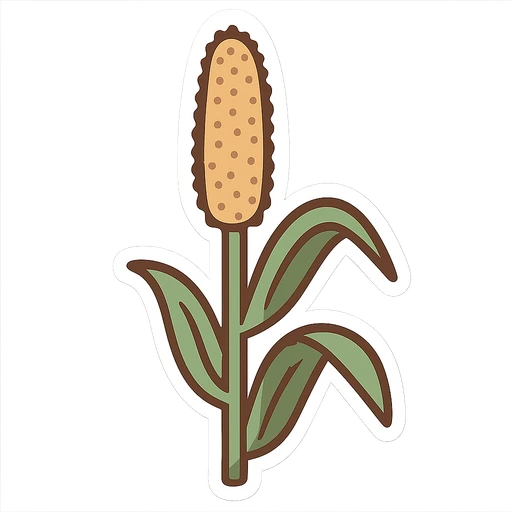
It's ready when seed heads are ready when the bristles (the hair-like awns surrounding each seed) dry to a tan or straw color and seeds resist thumbnail pressure without denting. Cut the entire seed head with 6 inches of stalk using sharp shears. Hang heads upside down in a dry, ventilated space for 1–2 weeks before threshing (rubbing or beating seeds free).

Store threshed, fully dry grain in airtight containers in a cool, dark location; properly dried grain keeps for 6–12 months.

Companions

Good neighbours, bad neighbours

Plant it with

Cowpea

Cowpea banks nitrogen in nodules on its roots, and most of it is released as those roots break down — so the payoff lands on next season's bed, not on this year's millet. Sown between millet rows it also covers bare ground while the grain is still short.

Groundnut

Groundnut feeds from deeper soil while millet's dense fibrous roots work the top layer, so the two can often share a bed without fighting over water. Give groundnut its own stake rather than letting it twine on grain stalks.

Sweet Potato

Sweet potato vines run flat across the ground between millet rows, shading the soil, slowing evaporation, and crowding out summer weeds that would otherwise compete with young grain.

Basil

Let a few basil plants at the block's edge flower and they draw in hoverflies and tiny parasitic wasps, which often reduce the aphid colonies that build on young millet stems and developing heads.

Keep it away from

Sorghum

Sorghum hosts the same downy mildew, rust, ergot, and head smut that trouble pearl millet, so planting them side by side stacks the risk and gives spores a short hop between crops. Keep them in separate beds and separate rotation years.

Sudangrass

Sudangrass is a close sorghum relative and carries the same leaf and head diseases as pearl millet; its fast, dense growth also out-muscles young grain for water and light. Grow it well away from a millet block.

See Pearl Millet in the full companion chart →

Crop rotation

After this crop

Family rest

Give grasses and grains 2 years away from this spot before any of its relatives return.

Good next crops

The pea and bean family, the squash family or the tomato family thrive in this ground next season.

Millet is a heavy feeder that leaves behind coarse, slow-rotting stalk and root residue — chop and turn it in, or compost it, to keep nitrogen from being tied up. Wait 2 years before any grass or grain returns here; legumes, squash family crops, or tomato family crops follow well.

Trouble to watch for

Pests and diseases

Pests

Aphids

Sign
Clusters of small soft-bodied insects on young stems and the base of developing seed heads; sticky residue on leaves.
Fix
Knock off with a firm water spray; apply insecticidal soap if colonies persist after two treatments.

Corn earworm

Sign
Ragged feeding damage inside the developing seed head; frass (insect droppings) visible between seeds.
Fix
Remove and destroy infested heads promptly; use row cover during early heading if pressure is high.

Grasshoppers

Sign
Irregular chewing damage on leaves and stems, often progressing rapidly across a planting.
Fix
Hand-pick in small gardens; apply kaolin clay barrier early in the season when nymphs first appear.

Shoot fly

Sign
Central shoot wilts and dies ('dead heart') in young seedlings while outer leaves remain green.
Fix
Remove and destroy affected plants; sow after soil is fully warm to reduce the window of seedling vulnerability.

Diseases

Downy mildew

Sign
Pale green to yellow streaking on leaves, white downy growth on leaf undersides; stunted, distorted plants.
Prevent
Use certified disease-free seed; space plants at the full 12 inches to allow airflow; avoid overhead irrigation.

Ergot

Sign
Honey-like liquid oozing from florets followed by hard, dark, elongated bodies replacing individual seeds in the head.
Prevent
Do not eat or save ergot-infected seed — the dark bodies are toxic; rotate away from millet for at least 2 years.

Rust

Sign
Small, powdery orange-brown pustules on leaf surfaces, usually appearing mid-season.
Prevent
Choose rust-resistant varieties where available; remove heavily infected leaves and dispose of them away from the bed.

Smut (head smut)

Sign
Entire seed head replaced by a mass of dark, powdery spores instead of grain.
Prevent
Source treated or certified clean seed; do not compost infected heads — bag and discard them.
FAQ

Common questions about Pearl Millet

When should I plant Pearl Millet?
Spring: 2 weeks after last frost, once soil reaches 65 °F (18 °C). Summer: up to 90 days before first fall frost for a second planting.
How long until Pearl Millet is ready to harvest?
75–100 days, counted from sowing. It's ready when seed heads are ready when the bristles (the hair-like awns surrounding each seed) dry to a tan or straw color and seeds resist thumbnail pressure without denting.
Can I grow Pearl Millet in a container?
Best in a raised bed or open ground; containers are impractical given the 4–8 ft height and extensive root system.
How often should I water Pearl Millet?
Water deeply once a week during establishment; reduce to every 10–14 days once plants are knee-high. Water when the top 2 inches of soil feel dry and lower leaves show the faintest curl.
How should I store Pearl Millet after harvest?
Store threshed, fully dry grain in airtight containers in a cool, dark location; properly dried grain keeps for 6–12 months.

Verdie turns this guide into your plan

Set your garden's location and every window above becomes a real date — then Verdie reminds you when it's time to sow, transplant, water, and pick.

Download on the App Store
Free to download · iPhone & iPad