Crop guide · The legume family

How to grow peanuts

A warm-season legume that buries its own fertilized flowers underground to produce pods, rewarding patient gardeners with a genuinely novel harvest.

Arachis hypogaea · also called groundnut, goober

Full sun Intermediate Frost-tender
Sun
Full sun
 
Frost
Tender
Any frost kills the foliage and halts pod development
Spacing
12 in
30 cm between plants
Sow depth
2 in
51 mm
To harvest
100–130 days
counted from sowing
Soil pH
5.0–8.0
slightly acidic to neutral
Timing

When to plant peanuts

Windows are counted from the average date of your last spring frost.

Too late?Skip sowing if fewer than 110 frost-free days remain before your first fall frost date.
Background

Why grow peanuts

Home-grown peanuts are harvested fresh — a texture and flavor unavailable in any store. As a legume, the plant fixes atmospheric nitrogen through root nodules, leaving the bed richer than it found it.

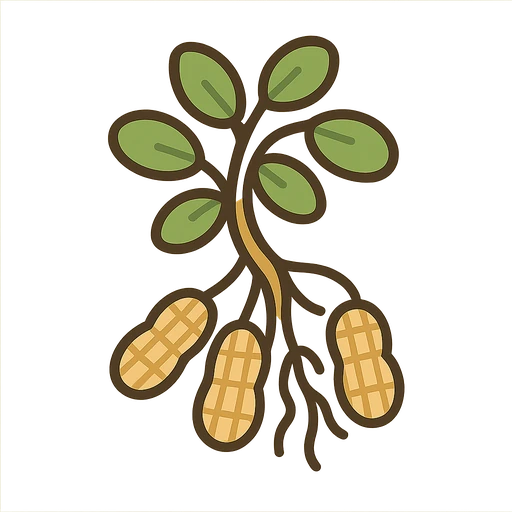
A little history. Native to South America, likely domesticated in what is now Bolivia or Argentina. After pollination, the flower stalk elongates and pushes the developing ovary (the 'peg') downward into the soil, where the pod matures underground.

The season, step by step

From planting to harvest

Start seeds indoors

4–6 weeks before last frost

Keep the top inch moist but not waterlogged; crusted soil blocks the emerging shoot — break any surface crust gently if rain is absent. Seedlings emerge in 7–14 days in warm soil.

Best soil temp 70–85 °F (21–29 °C) Minimum 65 °F (18 °C) Emerges in 7–14 days

Sow outside

2 weeks after last frost

Sow seeds 2 inches (51 mm) deep.

Water and feed

All season

Deep soak once or twice a week; reduce slightly once plants begin flowering to avoid waterlogged pegging zone. Water when the top 2 inches of soil feel dry. Aim for about 1 inch per week including rain.

Apply a low-nitrogen fertilizer at planting; side-dress (scatter fertilizer along the row and water in) with calcium-rich amendment at flowering. What to use: gypsum (calcium sulfate) at flowering — 1 lb per 10 sq ft — supports pod fill without disrupting soil pH.

Prune and maintain

As it grows

No pruning needed. Once yellow flowers appear, mound loose soil 2–3 inches around the base so the pegs (the elongating flower stalks that push into the ground) have easy entry into soft earth.

Harvest and store

100–130 days from sowing

It's ready when lift one plant and check pods: the inner hull shows dark veining and the papery skin inside the shell has turned pink or red — typically 100–130 days from sowing. Loosen soil with a fork 6 inches from the stem, then pull the entire plant by the base. Shake off loose soil and check that most pods are fully veined before harvesting the whole planting.

Cure whole plants upside-down in a warm, airy space at 85–95 °F (29–35 °C) for 2–3 weeks. Shell only when fully dry; store shelled peanuts in an airtight container in a cool, dry place for up to 3 months.

Companions

Good neighbours, bad neighbours

Plant it with

Sweet Corn

Peanut roots bank nitrogen in nodules, but most of it is released only as those roots break down, so it is next season's corn that benefits. Give corn its own row well to the side, since its shade can slow a sun-hungry peanut.

Sunflower

Sunflower heads feed hoverflies, lacewings, and tiny parasitic wasps, which often reduce the thrips and leafhoppers that streak peanut leaves. Set them on the north side so the tall stalks do not shade the peanut row.
Zucchini

Broad zucchini leaves shade bare ground, hold moisture, and crowd out weeds along the bed edge. Keep the vines out of the peanut row itself, since the pegs (the flower stalks that push into the soil) need open, loose earth to enter.

Potato

Gardeners have long grouped these two because both want deep, loose, stone-free soil and both get hilled with fresh earth. No mechanism has been demonstrated, so keep them in separate rows: digging potatoes disturbs peanut pegs and developing pods.

Keep it away from

Onion

Old charts keep the onion family away from beans, peas, and peanuts, though no mechanism has ever been shown. If you are short on beds, plant them apart rather than worrying; onions are shallow-rooted and mostly just compete for water in sandy soil.

Garlic

Garlic is said to sit poorly with legumes in the same century-old charts that separate onions from beans, with no demonstrated effect. The practical objection is timing: garlic is lifted in midsummer, and that digging disturbs peanuts just as pods are filling.

See peanuts in the full companion chart →

Crop rotation

After this crop

Family rest

Give the pea and bean family 2 years away from this spot before any of its relatives return.

Good next crops

The cabbage family, the beet family or grasses and grains thrive in this ground next season.

Peanuts are givers: their root nodules leave nitrogen behind as the roots break down. Keep the pea and bean family out of this bed for at least 2 years, then follow with hungry brassicas such as cabbage or broccoli, chenopods such as beets or chard, or a grass and grain crop like sweet corn.

Trouble to watch for

Pests and diseases

Pests

Thrips

Sign
Silvery streaking or stippling on leaves; tiny straw-colored insects visible with a hand lens.
Fix
Spray with insecticidal soap, covering leaf undersides; repeat every 5-7 days until populations drop.

Leafhoppers

Sign
Pale yellow wedge-shaped insects on leaf undersides; leaves show yellowing or 'hopperburn' at margins.
Fix
Apply insecticidal soap or kaolin clay barrier; remove heavily affected leaves.

Wireworms

Sign
Thin, hard, orange-brown larvae found in soil near roots; pods show small entry holes.
Fix
Avoid planting in beds that held grass sod the previous year; trap with buried carrot pieces and remove weekly.

Groundhogs (woodchucks)

Sign
Stems chewed at ground level; foliage stripped; disturbed soil near the bed edge.
Fix
Install a hardware-cloth fence buried 12 inches deep and bent outward underground to block digging.

Diseases

Early leaf spot

Sign
Circular brown spots with yellow halos on upper leaf surfaces, appearing from midsummer onward.
Prevent
Space plants at least 12 inches apart for airflow; avoid overhead watering; remove and bin affected leaves promptly.

Late leaf spot

Sign
Dark brown to black spots, mostly on leaf undersides, appearing later in the season than early leaf spot.
Prevent
Same cultural controls as early leaf spot; rotate peanuts out of the same bed for at least 3 years.

Southern stem rot (white mold)

Sign
White cottony growth at the soil line; stem collapses; small tan seed-like bodies visible in the white mat.
Prevent
Improve drainage; avoid dense planting; do not bury crop debris — remove and compost away from the bed.

Aflatoxin mold

Sign
Not visible at harvest — develops in pods stored while still moist; pods may show greenish or black discoloration.
Prevent
Cure harvested plants in a warm, well-ventilated spot for 2-3 weeks before shelling; never store damp pods.
Good to know:Raw or improperly stored pods can harbor aflatoxin-producing molds — always cure and dry pods thoroughly before eating or storing.
FAQ

Common questions about peanuts

When should I plant peanuts?
Spring: 2 weeks after last frost, once soil reaches 65 °F (18 °C). Spring: 4–6 weeks before last frost for very short-season climates.
How long until peanuts are ready to harvest?
100–130 days, counted from sowing. It's ready when lift one plant and check pods: the inner hull shows dark veining and the papery skin inside the shell has turned pink or red — typically 100–130 days from sowing.
Can I grow peanuts in a container?
Raised bed or deep in-ground bed strongly preferred; containers work only if very deep. In containers: 15-gallon pot, at least 18 inches deep.
How often should I water peanuts?
Deep soak once or twice a week; reduce slightly once plants begin flowering to avoid waterlogged pegging zone. Water when the top 2 inches of soil feel dry.
Is any part of peanuts unsafe to eat?
Raw or improperly stored pods can harbor aflatoxin-producing molds — always cure and dry pods thoroughly before eating or storing.
How should I store peanuts after harvest?
Cure whole plants upside-down in a warm, airy space at 85–95 °F (29–35 °C) for 2–3 weeks. Shell only when fully dry; store shelled peanuts in an airtight container in a cool, dry place for up to 3 months.

Verdie turns this guide into your plan

Set your garden's location and every window above becomes a real date — then Verdie reminds you when it's time to sow, transplant, water, and pick.

Download on the App Store
Free to download · iPhone & iPad