Start seeds indoors
Press seed lightly into moist mix; needs light to germinate — do not cover with soil. Keep surface evenly moist until sprouts appear. Seedlings emerge in 10–21 days in warm soil.
A towering, celery-scented perennial herb that delivers bold savory flavor from leaves, stems, seeds, and roots with almost no annual effort once established.
Levisticum officinale · also called sea parsley, love parsley
Windows are counted from the average date of your last spring frost.
One plant supplies a full season of celery-like flavor for soups, stocks, and salads without the fuss of growing celery itself. As a perennial, it returns reliably each spring and requires little maintenance beyond cutting back.
A little history. Native to southwestern Asia and naturalized across southern Europe, lovage is a robust perennial in the carrot family. Plants can reach 6 feet in height at flowering and develop a thick, branching taproot that persists for many years.
Press seed lightly into moist mix; needs light to germinate — do not cover with soil. Keep surface evenly moist until sprouts appear. Seedlings emerge in 10–21 days in warm soil.
Sow seeds ⅛ inch (3 mm) deep.
Best in a permanent bed with deep, rich soil; containers are possible but restrict the deep taproot and reduce long-term vigor. In containers: 15-gallon pot, at least 18 inches deep. Space plants 24 inches (60 cm) apart.
Water deeply once or twice a week during dry spells; established plants are moderately drought-tolerant. Water when the top 2 inches of soil feel dry to the touch. Aim for about 1 inch per week including rain.
Side-dress (scatter fertilizer along the plant's drip line and water in) once in early spring as new growth emerges, and again after a heavy harvest cut. What to use: balanced compost or a 5–5-5 organic granular fertilizer.
Cut flower stalks (the tall central stems that carry blooms) back to the base as soon as they appear to extend the leaf harvest by several weeks. Cut the whole plant to 4–6 inches in midsummer if foliage becomes coarse; it will flush fresh growth.
It's ready when harvest outer leaves once the plant has at least 6–8 healthy stems and leaves are fully expanded but still a deep, glossy green. Young stems are ready when pencil-thick. Cut individual outer stems at the base with clean scissors or a knife, leaving the inner crown intact. Take no more than one-third of the plant at a single harvest to maintain vigor.
Wrap stems loosely in a damp paper towel, seal in a bag, and refrigerate for up to 1 week. Leaves dry or freeze well for longer storage.
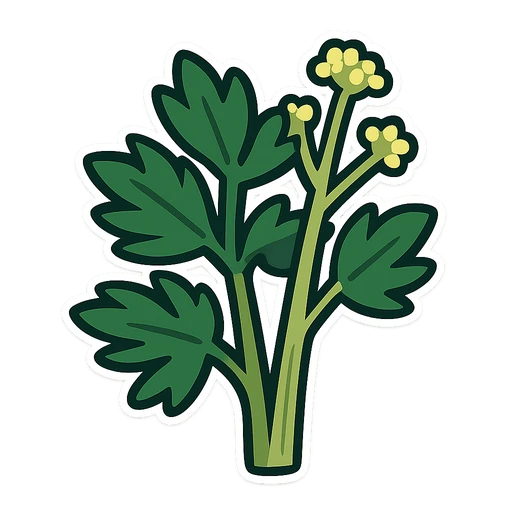
Cut stems to ground level after the first hard frost. Mulch the crown with 2–3 inches of straw or compost in cold climates. The plant re-sprouts from the root crown each spring without further intervention.
Tomato
Gardeners have long set lovage at the edge of the tomato patch, and old charts credit it with keeping tomatoes vigorous. No mechanism has been demonstrated, so treat it as tradition, and leave room: a mature clump reaches 6 feet and will shade tomatoes planted too close.
Garden Pea
Peas bank nitrogen in their roots. Cut the vines off at soil level and leave the roots in place, and most of that nitrogen reaches the lovage crown the following spring as the roots break down, not during the current season.
Nasturtium
Aphids often settle on nasturtium in preference to lovage's tender shoot tips. It only helps if you follow through: hose down or pull the colonized nasturtium before the colony builds and spills onto the herb.
Chives
The strong onion scent of a chive clump can help hide lovage from aphids and leaf-mining flies that find hosts by smell. The effect is modest and shows up best under low pest pressure, so plant the chives right at the base of the lovage.
Fennel
Fennel's roots release substances that stunt most garden vegetables, and young lovage set beside it stays small. Grow fennel at the far end of the garden, where its flat flower clusters still feed hoverflies and tiny parasitic wasps.
Dill
Both belong to the carrot family and host the same leaf blights and leaf-mining flies, so crowding them stacks the risk. Dill also self-sows freely and competes with the lovage crown for light and water. The two plants do not cross.
A perennial — it holds its spot for years, so it sits outside the annual rotation.
Lovage holds one spot for years, so it sits outside the annual rotation — give it a permanent corner where digging will not disturb the taproot. It feeds moderately; mulch the crown with compost each autumn. When a plant is finally removed, no family gap is needed before replanting.