Transplant outside
Either, but confine it — needs 12–15 inches of loose, stone-free soil to make a straight root. In containers: 15-gallon pot at least 18 inches deep; containment is the main reason to use one. Space plants 18 inches (45 cm) apart.
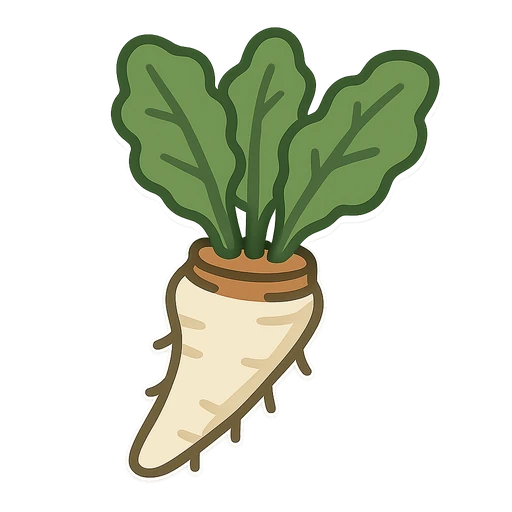
A tough cabbage-family perennial grown for its thick white root, which releases its heat only when the root is cut or grated.
Armoracia rusticana · also called Red cole, Great raifort
Windows are counted from the average date of your last spring frost.
One crown planted in spring gives a supply of fresh, far sharper root than any jar from the store, and it returns on its own every year with almost no attention.
A little history. Native to southeastern Europe and western Asia. The root is bland until cut: breaking the cells lets stored compounds react and turn sharp, a reaction that heat and vinegar both halt.
Either, but confine it — needs 12–15 inches of loose, stone-free soil to make a straight root. In containers: 15-gallon pot at least 18 inches deep; containment is the main reason to use one. Space plants 18 inches (45 cm) apart.
One deep soak a week from spring through fall. Water when the top 2 inches of soil feel dry. Aim for about 1 inch per week including rain.
Top-dress in early spring, then side-dress once in midsummer. What to use: compost or a balanced 5–5-5; go light on high-nitrogen feeds.
Snap off flower stalks as they rise. For a straighter root, scrape soil back in midsummer and rub off all side roots except the top few, then re-cover.
It's ready when dig after frost has knocked the leaves down — roots keep sizing up and gaining bite through the cool weeks of fall. Main root should be at least 1 inch thick. Cut the leaves back to a stub, loosen a circle about 12 inches out with a spading fork, then lever the main root up whole. Save pencil-thick side roots 8–14 inches long as next year's sets.
Store unwashed roots in damp sand or a sealed bag at 32–38 °F (0–3 °C) for 8–12 weeks. Once grated, the bite fades within a few weeks unless acidified or frozen.
Not a succession crop. Replant a few saved side roots each spring so you always have a first-year root coming on.
Fully winter hardy. Cut frosted leaves to the ground, mulch 4–6 inches, and dig roots during winter thaws; growth restarts on its own in spring.
Potato
Gardeners have long tucked a horseradish plant at the corners of the potato patch, and the habit persists, though no trial shows it moves potato beetles or rot. If you try it, sink the root in a bottomless bucket at the bed edge so it does not come up with every hill you dig.
Left to bloom in its second year, horseradish throws up branched clusters of small white flowers early in the season. That nectar can help hold hoverflies and tiny parasitic wasps in the garden before annual flowers open, which pays off on aphid-prone crops close by.
Carrot
Every root fragment left in the ground sprouts a new plant, so horseradish steadily colonizes a bed. Digging carrots chops and scatters those fragments, and the following season you are weeding horseradish out of the carrot rows. Keep it in its own confined corner.
Asparagus
Both are long-lived, but harvesting horseradish means forking down 12 inches or more, which slices through asparagus crowns you cannot replace. Give each perennial its own block with a clear walking strip between.
Cabbage
Horseradish is a cabbage-family plant and hosts the same flea beetles, cabbageworms, and white rust as heading brassicas. Because it stays in place year after year, it can carry those problems over winter into next spring's cabbage planting.
A perennial — it holds its spot for years, so it sits outside the annual rotation.
A permanent planting, so no rotation gap applies — give it a confined corner or a sunken bottomless container rather than a rotation bed. A moderate feeder: top-dress with compost each spring. If you ever remove it, sift out every root fragment for a full season before planting anything else there.