Transplant outside
2–4 weeks before last frost
Best as a permanent bed; needs 18 in of well-drained soil and room for arching canes. In containers: 20-gallon container, at least 18 in deep and wide. Space plants 30 inches (75 cm) apart.
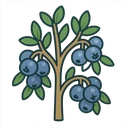
A native bramble with arching, blue-dusted canes that carry tight clusters of small, deep purple-black berries for about three weeks in early summer.
Rubus occidentalis · also called Blackcap, Blackcap raspberry

Set dormant plants 2–4 weeks before last frost, as soon as soil is workable.
Where winters are mild, plant 6 weeks before the ground freezes.
The fruit is too soft to ship, so growing your own is the practical way to get it. One planting produces for ten years or more on nothing but annual pruning and a spring feeding.
A little history. Native to eastern North America. Each cane lives two years: it grows one season, fruits the next, then dies. Arching tips root where they touch soil, which is how growers start new plants.
Best as a permanent bed; needs 18 in of well-drained soil and room for arching canes. In containers: 20-gallon container, at least 18 in deep and wide. Space plants 30 inches (75 cm) apart.
One deep soak a week; two while berries are sizing and ripening. Water when soil 2 in down feels dry at the base of the canes. Aim for 1 to 1.5 inches per week including rain.
Once in early spring before new shoots push; skip late-summer feeding. What to use: 1 inch of compost or a balanced 10–10-10 spread along the row and watered in.
In summer, cut new shoots back at 24–36 in tall to force side branches. After harvest, cut spent fruiting canes to the ground. In late winter, shorten side branches to 8–12 in.
It's ready when berries turn dull black, lose their shine, and drop into your hand at a light tug. Red or glossy fruit is not ripe and will be sour. Cup the berry and roll it off with your thumb; ripe fruit slips free of its core, leaving a hollow cap. Pick into shallow containers no more than 4 in deep so the bottom layer is not crushed.
Refrigerate unwashed in a single shallow layer and eat within 2–3 days. Wash only at serving time; wet berries break down fast.
Canes are hardy without protection in most areas. Spread 2–3 in of mulch over the root zone after the ground cools, keeping it off the cane bases.
 Sweet Alyssum
Low mats of alyssum bloom for months and draw in hoverflies whose larvae eat aphids. Aphids matter here beyond the leaf damage: they carry the viruses that shorten a black raspberry planting's productive life.
 Yarrow
Flat yarrow flower heads feed lacewings and tiny parasitic wasps that work over aphid colonies on cane tips. Set it at row ends rather than in the picking alley, where it would be trampled.
 Borage
Borage flowers steadily through early summer and pulls bumblebees into the planting. Each berry is a cluster of many small segments, and flowers worked thoroughly by bees set full, cohesive fruit instead of crumbly ones.
 White Clover
A mown clover alley between rows holds soil under picking traffic, keeps mud off low fruit, and crowds out weeds. Keep it out of the 12-inch strip at the base of the canes, where it would compete for water.
 Comfrey
Comfrey roots run far below the bramble's shallow feeder roots, so the two rarely fight over water at the row end. Cut leaves lay down as a coarse mulch under the canes.
 Raspberry
Aphids move viruses from red raspberries into black raspberries, which are far more sensitive and can decline within a few years. Extension guidance is to plant black raspberries at least 300 feet away, upwind if possible, and to pull wild brambles nearby.
Tomatoes, peppers, potatoes, and eggplant build up the soil fungus that causes wilt, and it survives for years after those crops are gone. Black raspberry canes then die off one at a time in midsummer. Choose ground that has not grown them for 4 years.
 Strawberry
Strawberries host the same soil-borne wilt fungus as the tomato family, so an old strawberry patch is a poor site for a new bramble row. Keep the two plantings separate and allow several years between them on the same ground.
A perennial — it holds its spot for years, so it sits outside the annual rotation.
This is a permanent planting, not part of any rotation — expect 10 years or more from one row. Choose the site carefully once: avoid ground that grew tomatoes, peppers, potatoes, eggplant, or strawberries in the past 4 years, since wilt fungus lingers there.
Set your garden's location and every window above becomes a real date — then Verdie reminds you when it's time to sow, transplant, water, and pick.