Crop guide · The mint family

How to grow Thai Basil

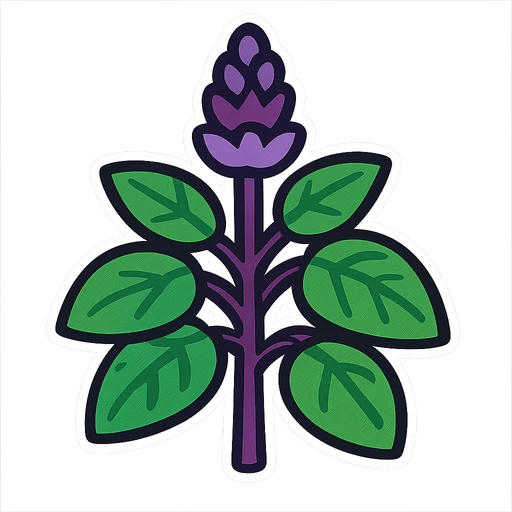
A compact, purple-stemmed basil with sturdy anise-scented leaves that hold their flavor through high heat and brief cooking — the standard herb in Southeast Asian kitchens.

Ocimum basilicum var. thyrsiflora · also called Thai sweet basil, anise basil

Full sun Beginner Frost-tender
Sun
Full sun
Light afternoon shade above 95 °F (35 °C) reduces leaf scorch without significantly reducing yield.
Frost
Tender
Killed by the first light frost
Spacing
12 in
30 cm between plants
Sow depth
¼ in
6 mm
To harvest
30–45 days
counted from transplant
Soil pH
6.0–7.0
slightly acidic to neutral
Timing

When to plant Thai Basil

Windows are counted from the average date of your last spring frost.

Summer:up to 10 weeks before first fall frost.
Too late?Skip direct sowing once fewer than 10 weeks remain before first fall frost — plants will not reach harvestable size.
Background

Why grow Thai Basil

Unlike common sweet basil, Thai basil resists wilting in hot weather and retains its distinctive flavor when stir-fried or added to soups. A single plant produces prolifically from midsummer through first frost with minimal intervention.

A little history. Native to tropical Asia; the characteristic anise-like scent comes from aromatic compounds concentrated in leaf glands. Purple stems and flower spikes are consistent varietal markers distinguishing it from sweet basil.

The season, step by step

From planting to harvest

Start seeds indoors

6–8 weeks before last frost

Press seeds lightly onto moist mix; do not bury deeper than ¼ inch. Keep surface evenly moist — seeds form a gel coat when wet and must not dry out before sprouting. Seedlings emerge in 5–10 days in warm soil.

Best soil temp 70–85 °F (21–29 °C) Minimum 60 °F (16 °C) Emerges in 5–10 days

Sow outside

After last frost

Sow seeds ¼ inch (6 mm) deep.

Water and feed

All season

Water deeply when the top inch of soil feels dry; typically every 2–3 days in warm weather. Water when leaves begin to look slightly dull or stems lose their upright posture. Aim for about 1 inch per week including rain.

Side-dress (scatter fertilizer along the base and water in) every 3–4 weeks once plants are 6 inches tall. What to use: balanced organic fertilizer such as 5–5-5 or compost tea; avoid high nitrogen once flowering begins.

Prune and maintain

As it grows

Pinch (remove with fingers or snips) the central growing tip once plants reach 6 inches to force branching. Remove flower spikes as soon as they appear — bolting (the shift from leaf growth to flowering) sharply reduces leaf production and flavor intensity.

Harvest and store

30–45 days from transplant

It's ready when harvest once stems carry at least 3 pairs of true leaves (the full-shaped leaves that follow the first rounded seed leaves). Leaves should be deep green, firm, and fragrant when lightly rubbed. Cut stems just above a leaf node (the point where a leaf meets the stem) using clean scissors. Never remove more than one-third of the plant at a time. Harvest in the morning after dew dries for peak flavor.

Stand cut stems in an inch of water at room temperature, away from direct sun — refrigeration blackens leaves. Use within 5–7 days, or blanch and freeze for longer storage.

Companions

Good neighbours, bad neighbours

Plant it with

Tomato

The strong anise scent of the foliage can help hide tomatoes from thrips and other pests that locate hosts by smell, and trials show modest reductions under low pest pressure. Plant a basil every second tomato, not a solid ring, so airflow stays open.

Bell Pepper

Gardeners have long tucked basil among peppers, and the two do share a taste for warm soil and steady moisture, but no measured pest or growth benefit has been demonstrated. Treat it as a convenient use of bed space rather than protection.

Eggplant

Aromatic basil foliage often reduces how readily flea beetles and thrips find eggplant leaves, though the effect fades once pest numbers climb. Keep 12 inches between plants so the basil does not trap humid air around eggplant stems.

French Marigold

French marigold flowers draw hoverflies and tiny parasitic wasps that work over aphid colonies on nearby basil. Its root-knot nematode suppression is real but only when the marigolds are planted thickly across a bed and turned into the soil at season's end, not as a few edge flowers.

Keep it away from

Fennel

Fennel roots release compounds that reliably stunt most garden vegetables, basil included, so seedlings set near it stall and stay small. Grown well away in its own corner, its flat flower heads feed hoverflies and tiny parasitic wasps, so it still earns garden space.

Sage

Old charts keep basil and sage apart, with no demonstrated mechanism behind the rule. The practical reason to separate them is water: sage prefers lean, dry soil while basil wants the top inch kept evenly moist, and one watering schedule cannot serve both.

See Thai Basil in the full companion chart →

Crop rotation

After this crop

Family rest

Easy-going — Thai Basil can grow almost anywhere in the rotation without a strict rest.

Good next crops

The pea and bean family, the cabbage family or the tomato family thrive in this ground next season.

A light feeder that leaves soil much as it found it, plus a thin layer of leafy residue. Wait 1 year before returning any mint-family herb here, and 2 years before basil specifically, since fusarium wilt lingers in soil. Legumes, brassicas, or nightshades all follow well.

Trouble to watch for

Pests and diseases

Pests

Aphids

Sign
Clusters of small soft-bodied insects on new growth and undersides of leaves; sticky residue on foliage.
Fix
Knock off with a firm water spray; apply insecticidal soap to undersides of leaves if colonies persist.

Japanese beetles

Sign
Irregular holes chewed through leaves, often leaving a lacy skeleton; metallic green-bronze beetles visible on plant.
Fix
Hand-pick beetles into soapy water in early morning when they are sluggish.

Thrips

Sign
Silver-streaked or stippled leaf surfaces; tiny elongated insects visible when leaf is held to light.
Fix
Remove heavily affected leaves; apply spinosad-based spray according to label directions.

Slugs

Sign
Ragged holes in lower leaves, especially after wet nights; silvery slime trails on soil or foliage.
Fix
Set out iron phosphate bait around the base of plants at dusk.

Diseases

Basil downy mildew

Sign
Yellow patches on upper leaf surface with a gray-purple fuzzy coating on the underside directly beneath; spreads rapidly in humid conditions.
Prevent
Space plants at least 12 inches apart for airflow; water at the base, not overhead; remove and bag affected leaves immediately.

Fusarium wilt

Sign
Sudden wilting of one or more stems despite adequate moisture; brown streaking visible inside the stem when cut lengthwise.
Prevent
Buy certified disease-free seed; do not replant basil in the same spot for at least 2 years; remove and dispose of affected plants — do not compost.

Gray mold (botrytis)

Sign
Soft brown lesions on stems or leaves covered with dusty gray spore masses, typically starting at damaged tissue.
Prevent
Improve air circulation; remove dead or damaged plant material promptly; avoid wetting foliage late in the day.
FAQ

Common questions about Thai Basil

When should I plant Thai Basil?
Spring: 6–8 weeks before last frost, transplant out after all frost risk has passed. Spring: after last frost when soil reaches 60 °F (16 °C).
How long until Thai Basil is ready to harvest?
30–45 days, counted from transplant. It's ready when harvest once stems carry at least 3 pairs of true leaves (the full-shaped leaves that follow the first rounded seed leaves). Leaves should be deep green, firm, and fragrant when lightly rubbed.
Can I grow Thai Basil in a container?
Either works well — needs at least 8 inches of soil depth and good drainage. In containers: 2-gallon pot minimum; 5-gallon preferred for sustained harvest.
How often should I water Thai Basil?
Water deeply when the top inch of soil feels dry; typically every 2–3 days in warm weather. Water when leaves begin to look slightly dull or stems lose their upright posture.
How should I store Thai Basil after harvest?
Stand cut stems in an inch of water at room temperature, away from direct sun — refrigeration blackens leaves. Use within 5–7 days, or blanch and freeze for longer storage.

Verdie turns this guide into your plan

Set your garden's location and every window above becomes a real date — then Verdie reminds you when it's time to sow, transplant, water, and pick.

Download on the App Store
Free to download · iPhone & iPad