Transplant outside
Raised beds or in-ground preferred; containers work short-term but restrict the root mass needed for full production. In containers: 25-gallon half-barrel minimum; repot every 2–3 years. Space plants 72 inches (185 cm) apart.
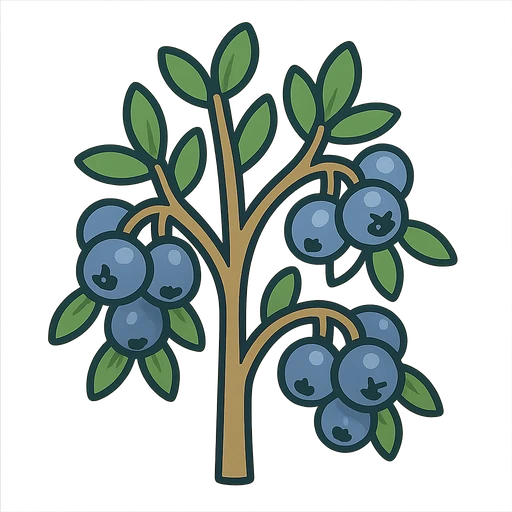
A heat-tolerant, long-lived blueberry native to the southeastern United States that produces heavy crops with minimal care once established.
Vaccinium virgatum · also called Rabbiteye blueberry, Southern blueberry
6–8 weeks before first expected frost, while soil is still warm enough to encourage root establishment.
As soon as the ground is workable, before new growth begins on the plant.
Rabbiteye blueberries tolerate summer heat and drought far better than northern highbush types, and a single mature plant can yield 10-20 pounds of fruit annually for decades. Two or more cultivars are required for reliable cross-pollination and full crops.
A little history. Native to the coastal plain of the southeastern US, rabbiteye blueberries are named for the pinkish-red stage the fruit passes through before ripening to blue — resembling a rabbit's eye. They require fewer winter chilling hours than highbush types.
Raised beds or in-ground preferred; containers work short-term but restrict the root mass needed for full production. In containers: 25-gallon half-barrel minimum; repot every 2–3 years. Space plants 72 inches (185 cm) apart.
Deep soak twice a week during the first two growing seasons; once established, water deeply during dry spells and fruit swell. Water when the top 2 inches of soil feel dry, or leaves show the first hint of dull, slightly inward curl. Aim for about 1–2 inches per week during fruiting.
Apply in early spring as buds swell, then again 6 weeks later; stop feeding by midsummer. What to use: acidifying fertilizer formulated for blueberries or rhododendrons; avoid high-phosphorus or lime-containing products.
Remove all flower buds in the first two years to redirect energy into root and cane development. From year three onward, prune in late winter: remove dead, crossing, or weak canes and any canes older than 6 years at the base to encourage vigorous new wood.
It's ready when berries are fully blue with a dusty, powdery bloom (waxy coating) and detach with the lightest touch; taste one — fully ripe fruit is sweet with no astringency. Cup a cluster in your palm and roll ripe berries off with your thumb; only fully blue, bloom-covered fruit releases easily. Leave firm or reddish berries — they will ripen over the following days.
Refrigerate unwashed in a shallow container for up to 2 weeks. Freeze in a single layer on a tray, then transfer to bags for up to 12 months.
Plant two or more cultivars with overlapping bloom times (e.g., one early and one mid-season) to ensure cross-pollination and extend the harvest window by 4–6 weeks.
Established plants are dormant and cold-hardy through winter in their adapted range. Mulch the root zone with 3–4 inches of pine bark to moderate soil temperature. Container plants should be moved to an unheated shelter if temperatures will drop below 10 °F (-12 °C).
Azaleas want the same strongly acidic, humus-rich, well-drained soil a rabbiteye blueberry needs, so one acidified, pine-bark-mulched bed serves both. Their roots are shallow and fibrous like the blueberry's, so neither digs into the other's zone.
Camellias share the blueberry's need for acidic soil, steady moisture, and a thick organic mulch, so both can be fed and watered on one schedule. Their winter bloom also brings early bees into the planting before blueberry flowers open.
Strawberry
A low strawberry carpet under the drip line shades the blueberry's shallow roots, holds moisture, and crowds out weeds you would otherwise have to pull by hand. Keep runners a foot clear of the crown so the bush is not competing for water in fruit swell.
Thyme
Flowering thyme feeds hoverflies, lacewings, and tiny parasitic wasps that work the bushes for aphids and small caterpillars. Thyme prefers sharper drainage and less acidity, so set it at the sunny bed edge rather than in the acidified root zone.
Black Walnut
Blueberries planted within the root spread of a black walnut reliably fail to thrive, showing stunted growth and dieback. Plant well outside the tree's canopy, and keep walnut leaves and hulls out of the mulch.
A perennial — it holds its spot for years, so it sits outside the annual rotation.
A long-lived perennial shrub with no rotation requirement — it holds the same ground for decades, so there is no family gap to count and no bed handed off to another crop. Keep the root zone permanently mulched and undisturbed rather than tilling around it each season.