Crop guide · The mint family

How to grow Purple Basil

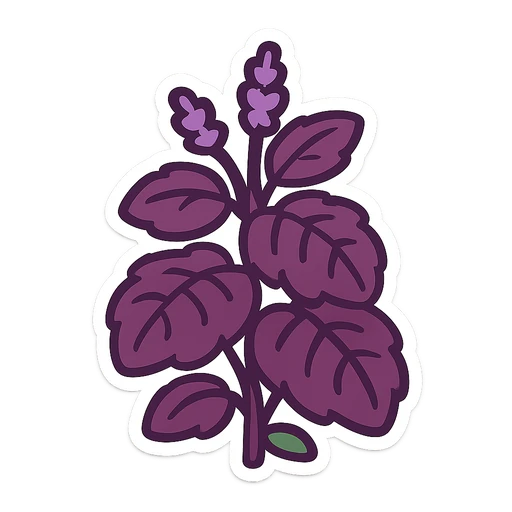
A richly pigmented basil with the same aromatic punch as green sweet basil, adding deep burgundy color to beds, borders, and plates alike.

Ocimum basilicum var. purpurascens · also called Dark Opal basil, Purple Ruffles basil

Full sun Beginner Frost-tender
Sun
Full sun
Light afternoon shade above 95 °F (35 °C) reduces wilting but may soften the purple pigmentation.
Frost
Tender
Blackened and killed by the first light frost
Spacing
12 in
30 cm between plants
Sow depth
¼ in
6 mm
To harvest
21–35 days
counted from transplant
Soil pH
6.0–7.0
slightly acidic to neutral
Timing

When to plant Purple Basil

Windows are counted from the average date of your last spring frost.

Too late?Skip sowing once fewer than 10 weeks remain before first fall frost — plants will not reach productive size before cold kills them.
Background

Why grow Purple Basil

The anthocyanin pigments (the same class of compounds that color red cabbage) that give the leaves their deep purple hue also make it a striking ornamental. It performs identically to green basil in the kitchen while doubling as a bedding plant.

A little history. Purple coloration in this variety results from elevated anthocyanin pigments in leaf tissue. Coloration intensifies under high light and moderate stress; shaded plants often revert toward green. Native range of the species is tropical Asia and Africa.

The season, step by step

From planting to harvest

Start seeds indoors

6–8 weeks before last frost

Press seeds onto moist mix; do not bury deeper than ¼ inch. Keep surface evenly moist — let it dry even once and germination stalls. Seedlings emerge in 5–10 days in warm soil.

Best soil temp 70–80 °F (21–27 °C) Minimum 60 °F (16 °C) Emerges in 5–10 days
Sow outside

2 weeks after last frost

Sow seeds ¼ inch (6 mm) deep.

Transplant outside

2 weeks after last frost

Either works well — needs at least 8 inches of soil depth and excellent drainage. In containers: 2-gallon pot minimum; 5-gallon preferred for sustained harvest. Space plants 12 inches (30 cm) apart.

Water and feed

All season

Water deeply when the top inch of soil feels dry, roughly every 2–3 days in warm weather. Water when leaves begin to lose their slight sheen and look marginally dull before wilting — water then. Aim for about 1 inch per week including rain; more in containers.

Side-dress (scatter fertilizer along the base and water in) or apply liquid feed every 3–4 weeks. What to use: balanced 5–5-5 organic or half-strength fish emulsion; avoid high nitrogen, which dilutes flavor.

Prune and maintain

As it grows

Pinch out the growing tip (the topmost cluster of leaves) once plants reach 6 inches tall, and remove any flower spikes (bolting stems) as soon as they appear. This keeps the plant bushy and delays the shift to seed production.

Harvest and store

21–35 days from transplant

It's ready when harvest once plants have at least 6 sets of leaves. Pick stems just above a leaf pair. Flavor peaks before any flower buds open. Cut stems back to just above the second or third set of leaves from the base using clean scissors. Never remove more than one-third of the plant at a single harvest.

Do not refrigerate — cold blackens leaves within hours. Stand cut stems in an inch of water at room temperature, loosely covered, for up to 5 days. Freeze as pesto for longer storage.

Companions

Good neighbours, bad neighbours

Plant it with

Tomato

The strong-smelling foliage can help hide tomatoes from thrips and whiteflies that hunt by scent, and trials show the effect is modest rather than absolute. Both crops want the same warm soil and steady water, so they share a bed easily.

Bell Pepper

Peppers and basil want identical conditions — warm soil, full sun, even moisture — and basil's low bushy frame shades the root zone without stealing light from taller pepper plants.

Oregano

Gardeners have long grown these two mint-family herbs side by side; they share sun and drainage needs and neither crowds the other. Give oregano its own corner, since it spreads wider each year.

French Marigold

French marigold flowers feed hoverflies and tiny parasitic wasps that hunt aphids on new basil growth. Its root-knot nematode suppression only works when planted thickly or turned into the soil at season's end, not as a few edge flowers.

Keep it away from

Sage

Old charts keep these apart, and there is a practical reason behind the tradition: sage prefers lean, dry soil while basil wants steady moisture and regular feeding, so one is always watered wrong. Grow them in separate pots.

Fennel

Fennel roots release compounds that stunt most garden vegetables, basil included — expect slowed, stalled seedlings nearby. Planted well apart at the garden edge, its flat flower heads feed hoverflies and tiny parasitic wasps, so it still earns a place.

See Purple Basil in the full companion chart →

Crop rotation

After this crop

Family rest

Easy-going — Purple Basil can grow almost anywhere in the rotation without a strict rest.

Good next crops

The pea and bean family, the cabbage family or the tomato family thrive in this ground next season.

Basil is a light feeder and pulls little from the bed, leaving soil in good shape. Leave a one-year gap before basil returns to the same spot. Peas or beans, a cabbage-family crop, or tomatoes and peppers all follow well here.

Trouble to watch for

Pests and diseases

Pests

Aphids

Sign
Clusters of tiny soft-bodied insects on new growth and undersides of leaves; sticky residue on foliage.
Fix
Knock off with a firm water spray; follow with insecticidal soap if reinfestation occurs within a week.

Japanese beetle

Sign
Irregular holes chewed through leaves, often leaving a lacy skeleton; metallic green-bronze beetles visible on foliage.
Fix
Hand-pick beetles into soapy water in the early morning when they are sluggish.

Thrips

Sign
Silver-streaked or stippled leaf surfaces; tiny, fast-moving sliver-shaped insects visible under a hand lens.
Fix
Remove heavily infested leaves; apply insecticidal soap to undersides of remaining foliage.

Diseases

Basil downy mildew

Sign
Yellow patches on upper leaf surface with a gray-purple fuzzy coating on the underside directly beneath the yellow areas.
Prevent
Space plants at least 12 inches apart for airflow; water at the base, not overhead; choose resistant varieties where available.

Fusarium wilt

Sign
Sudden wilting of one or more stems, brown streaking inside the stem when cut, stunted growth in young plants.
Prevent
Use certified disease-free seed; do not replant basil in the same spot for at least 3 years; improve drainage.

Botrytis (gray mold)

Sign
Soft brown lesions on stems or leaves, often covered with a dusty gray spore mass in humid conditions.
Prevent
Remove dead or damaged plant material promptly; improve air circulation; avoid wetting foliage late in the day.
FAQ

Common questions about Purple Basil

When should I plant Purple Basil?
Spring: 6–8 weeks before last frost, transplant out 2 weeks after last frost. Summer: direct sow once soil stays reliably above 60 °F (16 °C), typically 2 weeks after last frost.
How long until Purple Basil is ready to harvest?
21–35 days, counted from transplant. It's ready when harvest once plants have at least 6 sets of leaves. Pick stems just above a leaf pair. Flavor peaks before any flower buds open.
Can I grow Purple Basil in a container?
Either works well — needs at least 8 inches of soil depth and excellent drainage. In containers: 2-gallon pot minimum; 5-gallon preferred for sustained harvest.
How often should I water Purple Basil?
Water deeply when the top inch of soil feels dry, roughly every 2–3 days in warm weather. Water when leaves begin to lose their slight sheen and look marginally dull before wilting — water then.
How should I store Purple Basil after harvest?
Do not refrigerate — cold blackens leaves within hours. Stand cut stems in an inch of water at room temperature, loosely covered, for up to 5 days. Freeze as pesto for longer storage.

Verdie turns this guide into your plan

Set your garden's location and every window above becomes a real date — then Verdie reminds you when it's time to sow, transplant, water, and pick.

Download on the App Store
Free to download · iPhone & iPad