Start seeds indoors
Press seeds onto moist mix; do not cover — they need light to germinate. Mist daily to prevent the surface from drying out. Seedlings emerge in 7–21 days in warm soil.
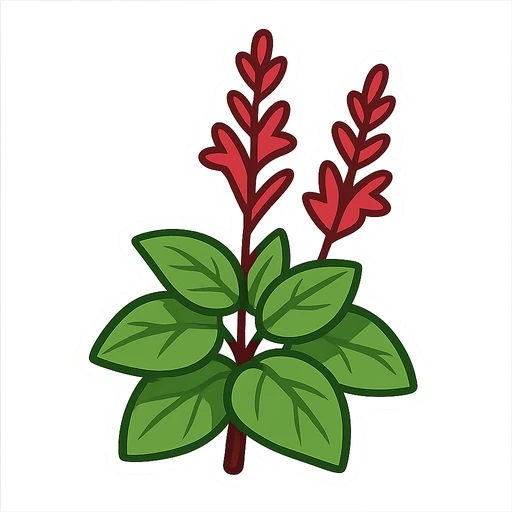
A tender perennial sage with pineapple-scented leaves and vivid scarlet late-season flowers that attract hummingbirds and pollinators.
Salvia elegans · also called Tangerine Sage, Fruit Sage
Windows are counted from the average date of your last spring frost.
Both leaves and flowers are edible, adding a fruity fragrance to teas, desserts, and salads. It fills a large container or border bed with lush foliage all summer, then delivers a dramatic floral display in autumn.
A little history. Native to the pine-oak forests of Mexico and Guatemala. A short-day plant — it initiates flower buds only when nights lengthen past roughly 12 hours, so bloom typically arrives in early to mid autumn regardless of when it was planted.
Press seeds onto moist mix; do not cover — they need light to germinate. Mist daily to prevent the surface from drying out. Seedlings emerge in 7–21 days in warm soil.
Either works well — needs at least 12 inches of soil depth and room to spread 3–4 feet wide at maturity. In containers: 15-gallon pot or half-barrel; roots need depth and volume to support large top growth. Space plants 36 inches (90 cm) apart.
Water deeply when the top inch of soil feels dry; roughly twice a week in warm weather. Water when leaves begin to droop slightly and lose their glossy sheen. Aim for about 1 inch per week including rain; more in containers.
Side-dress (scatter fertilizer along the root zone and water in) once in late spring and again in midsummer. What to use: balanced slow-release organic granules (5–5-5 or similar); avoid high nitrogen after midsummer.
Pinch (remove the growing tip between thumb and forefinger) stem tips back by one-third in late spring and again in early summer to encourage bushy branching. Cut back hard to 6–8 inches after frost kills the top growth.
It's ready when harvest leaves once the plant has at least 6–8 pairs of leaves and stems are firm. Flowers are ready when fully open and brightly colored. Cut stems just above a leaf node (the point where a leaf meets the stem) using clean scissors. Take no more than one-third of the plant at a time. Pick individual flowers by pinching at the base of the tube.
Use fresh for best fragrance. Wrap loosely in a damp paper towel, seal in a bag, and refrigerate up to 5 days. Dry leaves in a single layer at room temperature away from direct light.
In frost-prone climates, take 4-inch stem cuttings in late summer, root in moist perlite indoors, and overwinter on a bright windowsill above 40 °F (4 °C). Alternatively, pot up the whole plant before first frost and cut back by half.
Tomato
Pineapple sage's nectar-rich late flowers and steady leafy cover often bring in hoverflies, lacewings, and tiny parasitic wasps that hunt aphids and young hornworms on nearby tomatoes. Set it at the bed edge, since a mature plant claims 3-4 feet.
Basil
Two strongly scented herbs side by side can muddle the scent trail that pests such as whiteflies and aphids follow to a target plant. The effect is modest and works best under low pest pressure, not as a substitute for scouting.
French Marigold
French marigold roots release substances that reliably knock back root-knot nematodes, but only when the marigolds are grown as a thick block for a full season and turned into the soil afterward. A few flowers dotted along the edge will not do it.
Borage
Borage flowers through summer and pineapple sage takes over in autumn, so together they draw in bees and hummingbirds across a long stretch of the season. Give borage its own 18 inches, as it sprawls once it starts blooming.
Fennel
Fennel roots release substances that stunt most garden neighbours, and a young sage sharing its root zone will sit and sulk. Grown well apart in its own corner, though, fennel's flat flower heads feed hoverflies and tiny parasitic wasps, so it still earns a spot.
A perennial — it holds its spot for years, so it sits outside the annual rotation.
A perennial that stays put — leave it in place rather than working it into a rotation. It feeds moderately and returns woody stems and leaf litter that are worth composting. If you do lift or replace a clump, no waiting period is needed before replanting the spot.