Crop guide · The cabbage family

How to grow Field Mustard

A fast cool-season cover crop that puts on bulk top growth in six weeks and sends a taproot down through tight soil.

Brassica rapa subsp. oleifera · also called Turnip rape, Bird rape

Full sun Beginner Half-hardy
Sun
Full sun
Sowings made into soil above 75 °F (24 °C) flower small and stall
Frost
Half-hardy
Shrugs off light frost
Spacing
2 in
5 cm between plants
Sow depth
½ in
13 mm
To harvest
40–70 days
counted from sowing
Timing

When to plant Field Mustard

Windows are counted from the average date of your last spring frost.

Summer:late summer, into beds cleared of early crops.
Fall planting:at least 6 weeks before the first hard freeze.
Too late?Skip a fall sowing once you have fewer than 6 weeks before the first hard freeze — the stand will not make enough growth to be worth it.
Background

Why grow Field Mustard

It fills the gaps between food crops: covering bare beds against erosion, smothering weeds, and returning a heavy load of soft green matter when turned under.

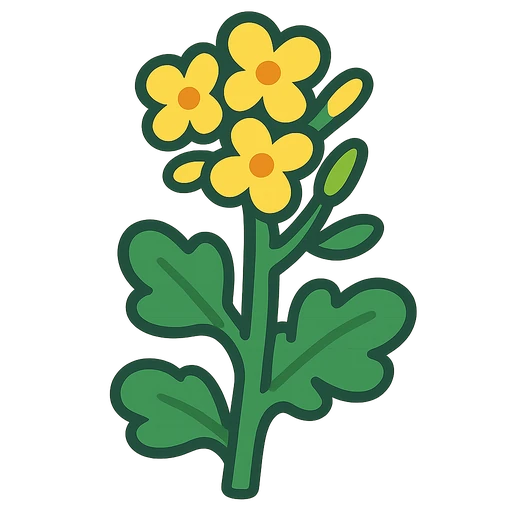
A little history. The same species as turnip and bok choy, selected for leaf and stem growth rather than a swollen root. Flowers are four-petaled and yellow, the standard cabbage-family pattern.

The season, step by step

From planting to harvest

Sow outside

4–6 weeks before last frost

Sow seeds ½ inch (13 mm) deep, and aim for 2 inches (5 cm) between plants once thinned. Sow shallow and firm the surface. Keep the top half-inch moist until sprouts show; a dry crust stops the tiny seeds cold. Seedlings emerge in 4–10 days.

Best soil temp 55–75 °F (13–24 °C) Minimum 45 °F (7 °C) Emerges in 4–10 days

Water and feed

All season

Water in at sowing, then only during a dry spell. Water when seedlings wilting by midday, or the top inch dry before the stand closes. Aim for about 1 inch per week including rain.

None on decent ground; feed once at sowing on worn-out soil. What to use: a light scatter of 5–5-5 organic fertilizer, about 1 lb per 100 sq ft, raked in.

Prune and maintain

As it grows

Mow or shear at about 12 in if growth gets ahead of you and let it regrow. Cutting before bloom keeps stems soft and easy to turn under.

Harvest and store

40–70 days from sowing

It's ready when ready to terminate when the top of each stalk shows its first open yellow flowers and stems still snap rather than bend. For the kitchen, cut young leaves with scissors while under 4 in. To end the stand, mow or shear at ground level at first bloom, then chop the tops and work them into the top 4–6 in of soil.

Young leaves keep 4–5 days in a bag in the crisper. Seed saved from dry pods stores in a sealed jar for about a year.

Companions

Good neighbours, bad neighbours

Plant it with

Crimson Clover

Sown as a mix, clover banks nitrogen in its roots while mustard puts up the bulk top growth. Most of that nitrogen is released the following season as the clover roots break down, so the crop that follows benefits rather than the mustard itself.

Field Pea

Field pea climbs lightly through a mustard stand and stores nitrogen in root nodules. Turn both under together and the nitrogen becomes available as the residue rots, mostly in time for next season's planting.
Oats

Oats spread a dense fibrous mat in the top few inches while mustard drives a single taproot deeper, so the two share the soil instead of fighting for it. Both also winterkill in hard freezes, leaving an even mat to plant through.

Phacelia

Both flower early and shallow, and together they keep hoverflies, lacewings, and tiny parasitic wasps fed for weeks. Those insects then work the aphids on nearby food crops.

Apple

Left to flower in the strip between fruit trees, mustard feeds bees and predatory insects at a time when little else is open. Mow it before pods set so it does not seed itself through the orchard floor.
Keep it away from

Beet

Chopped mustard residue releases sharp, short-lived compounds as it rots that can hold back the germination of small seeds. Beets are sown shallow and start slowly, so they are among the crops set back. Wait 2-3 weeks after turning mustard in before sowing beets.

Carrot

Fresh mustard residue often thins a carrot sowing, since carrot seed is tiny and takes two weeks to emerge even in clean ground. Let the chopped tops break down for 2-3 weeks, then rake and sow.

Small-seeded Direct-sown Greens

Lettuce, spinach, and other fine-seeded greens can germinate patchily in soil that still smells of freshly turned mustard. Transplants are unaffected — it is the germinating seed that suffers, so set out seedlings or wait out the residue.

See Field Mustard in the full companion chart →

Crop rotation

After this crop

Family rest

Give the cabbage family 4 years away from this spot before any of its relatives return.

Good next crops

The tomato family, the pea and bean family or the carrot family thrive in this ground next season.

A giver: it takes little and leaves a heavy load of soft green matter that feeds soil life as it rots. Keep cabbage-family crops out of this bed for 4 years. Follow with tomato-family crops, peas and beans, or carrot-family crops, sowing small seeds 2-3 weeks after turning it under.

Trouble to watch for

Pests and diseases

Pests

Flea beetles

Sign
Tiny round shot-holes across the seedling leaves; beetles jump when you brush the plants.
Fix
Cover the bed with fine mesh for the first two weeks after sprouting.

Cabbage aphids

Sign
Gray-green clusters packed into the growing tips and under leaves, with sticky film below.
Fix
Spray the tips hard with water, or cut and remove the worst stems.

Imported cabbageworm

Sign
Velvety green caterpillars chewing ragged holes; white butterflies working the stand.
Fix
Pick the caterpillars off by hand, or mow the stand early if damage is heavy.

Slugs

Sign
Shredded seedling leaves and slime trails on the soil after damp nights.
Fix
Set out iron phosphate bait or trap under boards, checking each morning.

Diseases

Clubroot

Sign
Stunted, wilting plants whose roots pull up swollen and clubbed instead of straight and branching.
Prevent
Keep cabbage-family crops out of infested beds for years, drain wet spots, and test soil before liming — lime suppresses this disease but never eradicates it.

Downy mildew

Sign
Pale yellow blotches on upper leaves with a gray-purple fuzz on the matching underside in cool damp weather.
Prevent
Sow at a normal rate rather than very thick so air moves through the stand, and water the soil rather than the leaves.

White mold

Sign
Water-soaked stem lesions turning to cottony white growth, with hard black lumps inside the collapsed stems.
Prevent
Avoid following beans, lettuce, or sunflowers in the same bed, and mow before the stand mats down wet.

Black rot

Sign
V-shaped yellow-brown wedges spreading in from leaf edges, veins darkening ahead of the dead tissue.
Prevent
Use clean seed, stay out of the bed while leaves are wet, and pull and bin infected plants rather than composting them.
FAQ

Common questions about Field Mustard

When should I plant Field Mustard?
Spring: 4–6 weeks before last frost, as soon as soil can be raked. Summer: late summer, into beds cleared of early crops.
How long until Field Mustard is ready to harvest?
40–70 days, counted from sowing. It's ready when ready to terminate when the top of each stalk shows its first open yellow flowers and stems still snap rather than bend.
Can I grow Field Mustard in a container?
Bed crop — broadcast over open ground; wants at least 8 in of workable soil for the taproot.
How often should I water Field Mustard?
Water in at sowing, then only during a dry spell. Water when seedlings wilting by midday, or the top inch dry before the stand closes.
How should I store Field Mustard after harvest?
Young leaves keep 4–5 days in a bag in the crisper. Seed saved from dry pods stores in a sealed jar for about a year.
Can Field Mustard stay in the ground over winter?
In mild winters plants survive and flower very early. Mow or turn them under before pods form, or you will weed volunteers all season.

Verdie turns this guide into your plan

Set your garden's location and every window above becomes a real date — then Verdie reminds you when it's time to sow, transplant, water, and pick.

Download on the App Store
Free to download · iPhone & iPad