Transplant outside
Beds strongly preferred; containers limit root run and reduce yield. Minimum 15-gallon container if no bed is available. In containers: 15-gallon pot, as wide and deep as possible. Space plants 60 inches (150 cm) apart.
A cold-hardy, self-fertile shrub that produces heavy clusters of intensely flavored dark berries with minimal fuss once established.
Ribes nigrum · also called blackcurrant, cassis
4–6 weeks before the ground freezes, while soil is still workable.
As soon as the ground can be worked, before buds break.
Black currants are exceptionally rich in vitamin C and produce reliably in cool climates where many soft fruits struggle. A single established bush can yield 10-15 lb of fruit annually with little intervention beyond annual pruning.
A little history. Native to northern and central Europe and northern Asia. A deciduous shrub in the Grossulariaceae family; self-fertile, meaning a single plant sets fruit without a pollination partner, though yields improve with cross-pollination.
Beds strongly preferred; containers limit root run and reduce yield. Minimum 15-gallon container if no bed is available. In containers: 15-gallon pot, as wide and deep as possible. Space plants 60 inches (150 cm) apart.
Deep soak once or twice a week during fruit swell; reduce after harvest. Water when the top 2 inches of soil feel dry, or leaves show slight midday wilt. Aim for about 1–1.5 inches per week during fruiting.
Side-dress (scatter fertilizer along the drip line and water in) once in early spring as buds swell, and again after harvest. What to use: high-nitrogen organic fertilizer or well-rotted manure in spring; balanced 5–5-5 after harvest.
In the dormant season, remove all stems older than 3 years at the base — old wood is darker and thicker. Keep 6–9 young stems. Black currants fruit best on one-year-old wood, so annual renewal pruning is essential for sustained yield.
It's ready when entire strigs (the small stems holding a cluster of berries) turn uniformly deep purple-black and berries feel slightly soft; taste one — ripe fruit is tart-sweet with no green astringency. Pick whole strigs by snipping or pulling the cluster stem, not individual berries. Harvest over 1–2 weeks as clusters ripen unevenly across the bush. Handle gently — skins bruise easily.
Refrigerate unwashed in a shallow container for up to 5 days. Freeze on a tray then transfer to bags for up to 12 months. Do not wash until ready to use.
No action needed for established plants in cold climates — they are fully dormant and cold-hardy. In the first winter after planting, a light mulch of straw over the root zone helps in areas with freeze-thaw cycles.
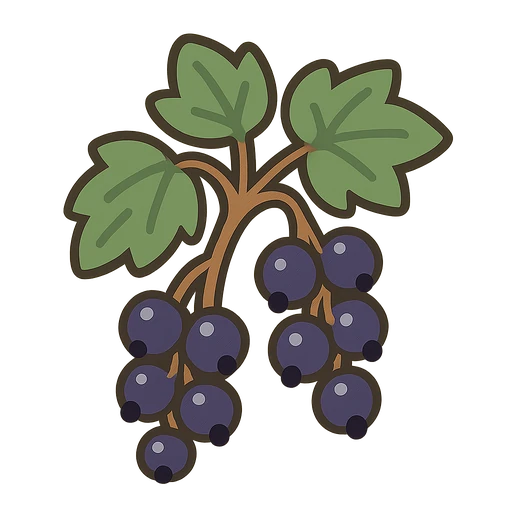
Garlic
Gardeners have long ringed currant bushes with garlic, on the idea that its strong smell confuses aphids hunting by scent. Evidence in fruit plantings is thin, so treat it as a harmless habit rather than a control measure.
Chives
A clump of chives at the drip line can help mask the bush from aphids that locate hosts by smell, and its early flowers draw hoverflies whose larvae eat aphid colonies. Expect a modest effect under low pest pressure, not a fix for an outbreak.
Hyssop
Hyssop flowers over a long stretch of summer and draws in hoverflies, lacewings, and tiny parasitic wasps that work over aphid colonies on nearby currant shoots. Plant it a few feet out so it does not crowd the bush.
Tansy
Old charts pair tansy with currants for pest deterrence, though the claim has not held up in trials. Its flat flower heads do feed hoverflies and parasitic wasps, so keep it as an edge plant and cut the seed heads before it self-sows through the bed.
White pine blister rust needs both a currant and a five-needled pine to complete its life cycle, so growing them within a few hundred feet of each other stacks the risk for both. Some states still restrict currant planting where these pines grow.
Eastern white pine is the main alternate host for white pine blister rust in North America. Currants planted near one can pass the disease to the tree, where it kills branches outright; check local rules and choose rust-resistant stock.
A perennial — it holds its spot for years, so it sits outside the annual rotation.
A permanent shrub, not part of a rotation — it holds its ground for 12-15 years, so site it where you will not need to dig. It is a moderate feeder that returns leaf litter and root mass to the soil; keep the root zone mulched and undisturbed rather than replanting the spot.