Transplant outside
Beds strongly preferred for long-term productivity; containers work short-term in at least a 15-gallon pot with excellent drainage. In containers: 15-gallon pot, minimum 18 inches deep. Space plants 60 inches (150 cm) apart.
A compact, cold-hardy shrub that produces heavy clusters of jewel-bright, tart berries with minimal fuss in cool-temperate gardens.
Ribes rubrum · also called garden currant, common red currant
4–6 weeks before the ground freezes, while soil is still workable.
As soon as the ground can be worked, before buds break.
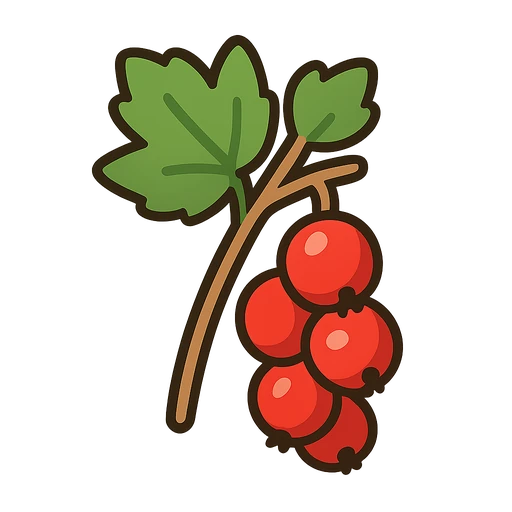
Red currants fruit reliably in climates too cool for many soft fruits, tolerate partial shade better than most fruiting shrubs, and bear for 10–15 years from a single planting. The berries are rarely found fresh in markets, making home-grown fruit genuinely worthwhile.
A little history. Native to western Europe and northern Asia, red currant is a deciduous shrub in the gooseberry family. It fruits on short spurs (stubby side shoots) on wood two years old and older, which is why old wood is retained at pruning.
Beds strongly preferred for long-term productivity; containers work short-term in at least a 15-gallon pot with excellent drainage. In containers: 15-gallon pot, minimum 18 inches deep. Space plants 60 inches (150 cm) apart.
Deep soak once or twice a week during fruit swell; reduce after harvest. Water when the top 2 inches of soil feel dry, or leaves show slight midday wilt. Aim for about 1 inch per week; more during fruit swell in warm spells.
Side-dress (scatter fertilizer along the drip line and water in) once in early spring as buds swell, and once after harvest. What to use: balanced 5–5-5 organic or a top-dressing of well-rotted compost, 2–3 inches deep.
In late winter before bud break, remove wood older than 3 years at the base, crossing branches, and weak growth. Retain 8–12 healthy stems of mixed ages. This keeps fruiting spurs young and the center open to airflow.
It's ready when entire strigs (the small hanging clusters) turn uniformly deep red and feel slightly soft; taste a berry — ripe fruit is tart-sweet with no green astringency. All berries on a strig ripen together. Harvest whole strigs by snipping or pulling the cluster stem, not individual berries. Pick when dry. A full bush can be stripped in one or two passes over 1–2 weeks.
Refrigerate unwashed strigs in a shallow container for up to 1 week. Freeze on a tray then bag for up to 12 months. Strip from stems before freezing if preferred.
No action needed for established plants in cold climates — they are fully dormant and cold-hardy. In the first winter after planting, a 3-inch mulch layer over the root zone protects against frost heave (soil expanding and contracting that can lift shallow roots).
Garlic
Gardeners have long tucked garlic around the base of currant bushes on the idea that its strong smell hides the shrub from pests that hunt by scent. Evidence is thin, but garlic takes little room at the drip line and is lifted before the berries ripen.
Chives
Let a clump of chives flower near the bush and it often draws hoverflies and lacewings, whose larvae feed on currant aphids. Keep the clump 18 inches out from the stems so it does not compete for surface moisture.
Hyssop
Hyssop blooms through summer and can keep hoverflies, ladybugs, and tiny parasitic wasps in the fruit patch after the currants have flowered, which helps hold aphid numbers down on new shoots.
French Marigold
French marigold flowers feed hoverflies and small parasitic wasps that work over aphid colonies. Its root-knot nematode effect only shows when it is grown as a thick block and turned into the soil at season's end, not from a few plants at the edge.
White pine blister rust needs both hosts to complete its life cycle: it spends part of the year on currants and part on five-needle pines, killing the pines. Keep currants well away from white pines and check local rules, since planting is still restricted in some areas.
Fennel
Fennel roots release compounds that stunt most garden plants around them, so keep it out of the fruit bed. Its flowers do feed hoverflies and tiny parasitic wasps, so it earns a place in a corner of its own well away from the bushes.
Pinon
Currants are the alternate host white pine blister rust needs to finish its life cycle; spores move from currant leaves to pine bark. Keep currants at least 300 feet from any pine you value.
Korean Pine
White pine blister rust must pass through a currant leaf to complete its life cycle, so planting the two together stacks the risk for both. Keep currants at least 1,000 feet from five-needled pines where the rust occurs.
A perennial — it holds its spot for years, so it sits outside the annual rotation.
Red currant is a permanent planting, so no rotation gap applies. It is a moderate feeder that repays an annual compost top-dressing. If a bush is removed, plant the replacement currant or gooseberry elsewhere and give the old spot to vegetables instead.