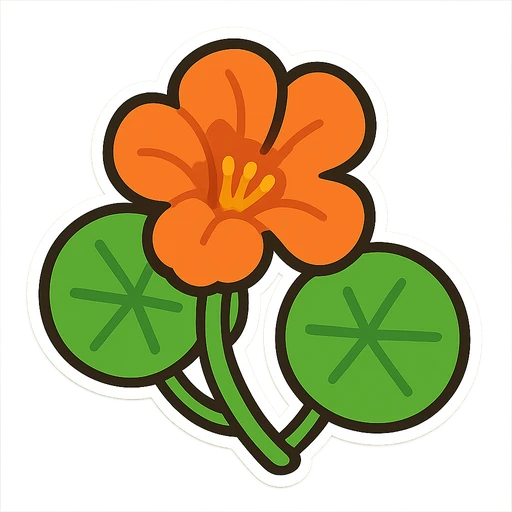
Crop guide · The nasturtium family (Tropaeolaceae)
How to grow nasturtiums
A fast-growing annual with edible flowers, leaves, and seeds that earns its space with almost no effort from the gardener.
Tropaeolum majus · also called garden nasturtium, Indian cress
Full sunBeginnerFrost-tender
Sun
Full sun
Provide afternoon shade once temperatures stay above 85 °F (29 °C) to extend the flowering period and reduce leaf scorch.
Frost
Tender
Killed by the first light frost. Harvest all flowers and seeds before a frost warning
Spacing
10 in
25 cm between plants
Sow depth
½ in
13 mm
To harvest
50–70 days
counted from sowing
Soil pH
6.0–7.5
slightly acidic to neutral
Timing
When to plant nasturtiums
Windows are counted from the average date of your last spring frost.
Last frost
Direct sow outside
1–2 weeks after1–2 weeks after last frost, once soil reaches 55 °F (13 °C).
First harvest
8–12 weeks after50–70 days counted from sowing, so first pickings start around 8 weeks after the last frost.
−20+2+4+6+8+10+12+14
Weeks relative to last spring frost
Fall planting:8–10 weeks before first fall frost in mild climates.
Too late?Skip a spring sowing once daytime temperatures regularly exceed 90 °F (32 °C) — heat stops flowering; sow again 10 weeks before first fall frost.
Background
Why grow nasturtiums
Every part above ground is edible, with a peppery bite similar to watercress. It flowers prolifically in poor soil where most crops would struggle, and the blooms attract beneficial insects while deterring some common pests.
A little history. Native to the Andes of South America; introduced to Europe in the late 16th century. The genus name derives from the Greek for 'trophy,' referencing the shield-like leaves and helmet-shaped flowers.
The season, step by step
From planting to harvest
Sow outside
1–2 weeks after last frost
Sow seeds ½ inch (13 mm) deep, and aim for 10 inches (25 cm) between plants once thinned. Soak seeds overnight before sowing. Cover with half an inch of soil and keep evenly moist until sprouts appear. Seedlings emerge in 7–14 days.
Best soil temp 65–70 °F (18–21 °C)Minimum 55 °F (13 °C)Emerges in 7–14 days
Water and feed
All season
Water deeply once or twice a week; allow the soil to dry slightly between waterings. Water when the top inch of soil feels dry to the touch. Aim for about 1 inch per week including rain.
Feed sparingly — once at planting, then only if leaves pale noticeably. What to use: a low-nitrogen balanced fertilizer or dilute compost tea; excess nitrogen drives leaves at the expense of flowers.
Prune and maintain
As it grows
Pinch (remove the growing tip between thumb and forefinger) on young plants to encourage bushy growth. Deadhead (remove spent flowers) regularly to extend the blooming period.
Harvest and store
50–70 days from sowing
It's ready when flowers are fully open and brightly colored. Leaves are ready at any size but are mildest when young. Seed pods are ready when plump, round, and still bright green. Snap flowers off at the base of the stem with your fingers. Cut leaves with scissors, taking no more than one-third of the plant at a time. Twist green seed pods free by hand.
Use flowers and leaves the same day for best flavor. Seed pods keep in a sealed container in the refrigerator for up to 1 week. Mature dried seeds store in a cool, dry place for up to 1 year.
Keep it coming
Sow a second batch 3–4 weeks after the first to maintain a continuous harvest of young leaves and fresh flowers through the season.
Nasturtium's open, nectar-rich flowers draw bees into the patch, and cucumbers need repeated bee visits to set straight, well-filled fruit. Sow a few plants at the row ends where they will not shade the vines.
Zucchini carries separate male and female flowers and depends on bees to move pollen between them; nasturtium blooming nearby can help keep pollinators in the bed through the morning hours when squash flowers are open.
Flea beetles and cabbage white caterpillars often settle on nasturtium leaves in preference to radish tops. Check the nasturtiums weekly and pull or clip infested growth, or the trap simply becomes a pest nursery.
Black bean aphids crowd onto nasturtium stems and can pull some pressure off young tomato shoots. Treat it as a decoy you must manage: cut out heavily colonised stems rather than leaving them to build up.
The Cabbage Family
Cabbage white butterflies will lay on nasturtium as readily as on cabbage or kale, so a border of it often reduces eggs on the crop. Scout the nasturtium leaf undersides and crush egg clusters, or the caterpillars move on to the brassicas.
Fennel roots release compounds that stunt most garden neighbours, nasturtium included, leaving small plants with few flowers. Grow fennel in its own corner or a pot, where its umbels still feed hoverflies and tiny parasitic wasps that patrol the whole garden.
Easy-going — Nasturtium can grow almost anywhere in the rotation without a strict rest.
Good next crops
The pea and bean family, the cabbage family or the tomato family thrive in this ground next season.
A light feeder that takes little from the bed and leaves loose, easily worked soil behind. Wait one year before returning nasturtium to the same ground, then follow with legumes such as peas or beans, a cabbage-family crop, or tomatoes and peppers.
Trouble to watch for
Pests and diseases
Pests
Black bean aphid
Sign
Dense clusters of small black insects on stems and the undersides of leaves; sticky residue on foliage.
Fix
Blast off with a firm jet of water; repeat daily for a week. Nasturtiums often act as a trap crop — remove heavily infested stems to protect nearby vegetables.
Cabbage white caterpillar
Sign
Ragged holes in leaves; pale green caterpillars visible on leaf undersides.
Fix
Hand-pick caterpillars and drop into soapy water. Check undersides of leaves for yellow egg clusters and crush them.
Flea beetle
Sign
Tiny round holes scattered across leaves, giving a shot-hole appearance.
Fix
Cover young plants with fine insect mesh until established; remove mesh once plants are vigorous.
Diseases
Powdery mildew
Sign
White powdery coating on upper leaf surfaces, typically in late summer when nights cool and humidity rises.
Prevent
Space plants at least 10 inches apart for airflow; avoid overhead watering in the evening. Remove affected leaves promptly.
Bacterial soft rot
Sign
Water-soaked, collapsing stems at the base; foul smell; usually follows overwatering or poor drainage.
Prevent
Ensure containers and beds drain freely; do not water again until the top inch of soil is dry.
FAQ
Common questions about nasturtiums
When should I plant nasturtiums?
Spring: 1–2 weeks after last frost, once soil reaches 55 °F (13 °C). Fall: 8–10 weeks before first fall frost in mild climates.
How long until nasturtiums are ready to harvest?
50–70 days, counted from sowing. It's ready when flowers are fully open and brightly colored. Leaves are ready at any size but are mildest when young. Seed pods are ready when plump, round, and still bright green.
Can I grow nasturtiums in a container?
Either works well — needs only 6–8 inches of soil depth; trailing types spill attractively over pot edges. In containers: 2-gallon pot minimum; 5-gallon for trailing varieties.
How often should I water nasturtiums?
Water deeply once or twice a week; allow the soil to dry slightly between waterings. Water when the top inch of soil feels dry to the touch.
How should I store nasturtiums after harvest?
Use flowers and leaves the same day for best flavor. Seed pods keep in a sealed container in the refrigerator for up to 1 week. Mature dried seeds store in a cool, dry place for up to 1 year.
Verdie turns this guide into your plan
Set your garden's location and every window above becomes a real date — then Verdie reminds you when it's time to sow, transplant, water, and pick.
 Cucumber
 Zucchini
 Radish
 Tomato
 Fennel