Crop guide · The hemp family

How to grow Hops

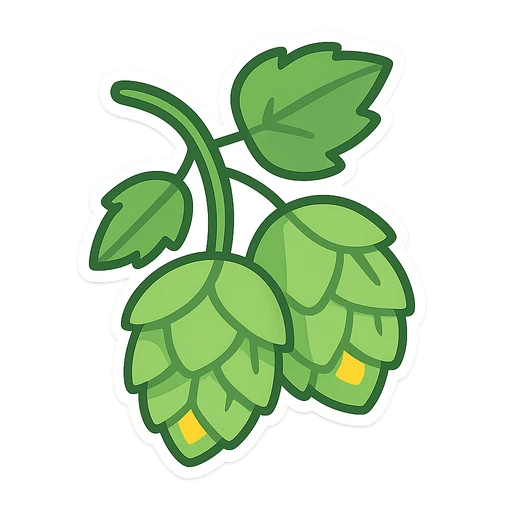
A vigorous perennial climbing bine grown for its papery, aromatic cone-shaped flowers used in brewing and herbal preparations.

Humulus lupulus · also called common hops, bine

Full sun Intermediate Frost-hardy
Sun
Full sun
Provide afternoon shade once temperatures regularly exceed 95 °F (35 °C) to reduce cone stress and slow powdery mildew pressure.
Frost
Hardy
Established crowns survive hard frost
Spacing
36 in
90 cm between plants
Sow depth
2 in
51 mm
To harvest
120–150 days
counted from transplant
Soil pH
6.0–7.5
slightly acidic to neutral
Timing

When to plant Hops

Windows are counted from the average date of your last spring frost.

Too late?Skip planting if the growing season has fewer than 120 frost-free days remaining — rhizomes planted too late will not establish before dormancy.
Background

Why grow Hops

Home brewers gain access to fresh, varietal hops unavailable in most shops. The plant also provides rapid seasonal screening — a mature crown can send shoots 20 feet or more in a single season.

A little history. A dioecious (separate male and female plants) perennial; only female plants produce cones. Commercially grown plants are all female, propagated by rhizome division to keep populations seedless.

The season, step by step

From planting to harvest

Transplant outside

After last frost

Strongly prefers a deep in-ground bed; containers restrict the root crown and reduce yield significantly after year one. In containers: 25-gallon or larger half-barrel; expect reduced yield. Space plants 36 inches (90 cm) apart.

Water and feed

All season

Deep soak twice a week during active growth; reduce to once a week once cones begin to form. Water when the top 2 inches of soil feel dry. Aim for about 1–2 inches per week including rain.

Side-dress (scatter fertilizer along the row and water in) once in early spring when shoots emerge, then again at 6 weeks. What to use: balanced 10–10-10 or compost-enriched organic blend; avoid high nitrogen after midsummer.

Prune and maintain

As it grows

Train 2–3 strongest shoots per string upward; cut all others at ground level in early spring. Pinch (remove the growing tip) lateral shoots below 18 inches to improve airflow and direct energy to upper cones.

Harvest and store

120–150 days from transplant

It's ready when cones feel dry and papery, spring back when squeezed, and release a strong resinous aroma when rubbed. The base of each cone turns slightly yellow-green. Lupulin (yellow powder inside) is visible when a cone is split open. Cut entire bine (the twining stem of a hop plant, distinct from a tendril-climbing vine) down from its support. Strip cones by hand into a breathable bag. Harvest the whole plant at once — cones on a single bine ripen within a narrow window.

Dry cones in a single layer at 140 °F (60 °C) or below until moisture drops to about 8–10%; vacuum-seal in airtight bags and freeze. Use within 12 months for best brewing quality.
Companions

Good neighbours, bad neighbours

Plant it with

Comfrey

Comfrey's deep taproot works well below the hop crown's feeding roots, so the two share the same permanent bed without fighting for water. Cut comfrey leaves several times a season and lay them over the crown as a mulch.

Yarrow

Yarrow's flat flower heads draw in hoverflies, lacewings, ladybugs, and tiny parasitic wasps, the same predators that clear hop aphid colonies off young shoots. Plant it at the base of the trellis where it flowers through the aphid season.

French Marigold

French marigold can reduce root-knot nematodes in the soil, but only when sown thickly across the whole area or turned into the ground at season's end — a few flowers at the bed edge do nothing. Best used the year before a hop crown goes in.

Keep it away from

Fennel

Fennel roots release compounds that stunt most garden plants nearby, and a hop crown sits in the same spot for a decade. Keep fennel in its own corner well away from the trellis, where its flowers still feed hoverflies and tiny parasitic wasps.

See Hops in the full companion chart →

Crop rotation

After this crop

Rotation

A perennial — it holds its spot for years, so it sits outside the annual rotation.

Hops is a long-lived perennial that holds one bed for ten years or more, so it takes no place in an annual rotation — rotate yearly vegetables around the crown instead. If wilt has struck, wait at least 4 years before replanting hops in that ground.

Trouble to watch for

Pests and diseases

Pests

Hop aphid

Sign
Dense colonies of pale green insects on undersides of leaves and young shoots; sticky honeydew residue and distorted growth.
Fix
Knock off with a strong water jet; apply insecticidal soap to undersides of leaves, repeating every 5-7 days until colonies collapse.

Spider mite

Sign
Fine stippling on upper leaf surfaces, bronze discoloration, and fine webbing on undersides in hot dry weather.
Fix
Increase humidity around foliage with overhead watering in early morning; apply neem oil spray to undersides of leaves.

Hop looper caterpillar

Sign
Ragged holes in leaves and partially eaten cones; frass (insect droppings) visible on foliage.
Fix
Hand-pick caterpillars at dusk; apply Bacillus thuringiensis (Bt) spray to foliage at first sign of feeding.

Diseases

Powdery mildew

Sign
White powdery coating on upper leaf surfaces and cone bracts; affected cones turn brown and lose aroma.
Prevent
Space plants for airflow; train shoots vertically; remove basal leaves to 3 feet; apply sulfur-based fungicide at bud swell if mildew was present the prior year.

Downy mildew

Sign
Pale yellow patches on upper leaf surfaces with corresponding gray-purple fuzz beneath; shoot tips curl downward into a 'basal spike' shape.
Prevent
Remove and destroy infected basal spikes immediately; avoid overhead watering; choose resistant varieties such as Nugget or Chinook.

Crown rot (Verticillium wilt)

Sign
Sudden wilting of one or more bines mid-season; brown streaking inside the stem when cut; crown tissue turns dark.
Prevent
Plant in well-drained soil; avoid wounding the crown during cultivation; do not replant hops in a bed where wilt has occurred for at least 4 years.
Good to know:Young shoots are edible as a vegetable; mature leaves and roots are not typically consumed. Dogs and cats are sensitive to hops — keep harvested material away from pets.
FAQ

Common questions about Hops

When should I plant Hops?
Spring: after last frost, once soil reaches 50 °F (10 °C) — typically mid to late spring.
How long until Hops are ready to harvest?
120–150 days, counted from transplant. It's ready when cones feel dry and papery, spring back when squeezed, and release a strong resinous aroma when rubbed. The base of each cone turns slightly yellow-green. Lupulin (yellow powder inside) is visible when a cone is split open.
Can I grow Hops in a container?
Strongly prefers a deep in-ground bed; containers restrict the root crown and reduce yield significantly after year one. In containers: 25-gallon or larger half-barrel; expect reduced yield.
How often should I water Hops?
Deep soak twice a week during active growth; reduce to once a week once cones begin to form. Water when the top 2 inches of soil feel dry.
Is any part of Hops unsafe to eat?
Young shoots are edible as a vegetable; mature leaves and roots are not typically consumed. Dogs and cats are sensitive to hops — keep harvested material away from pets.
How should I store Hops after harvest?
Dry cones in a single layer at 140 °F (60 °C) or below until moisture drops to about 8–10%; vacuum-seal in airtight bags and freeze. Use within 12 months for best brewing quality.

Verdie turns this guide into your plan

Set your garden's location and every window above becomes a real date — then Verdie reminds you when it's time to sow, transplant, water, and pick.

Download on the App Store
Free to download · iPhone & iPad