Start seeds indoors
Cover seeds with ¼ inch of fine mix; keep the medium evenly moist and above 75 °F (24 °C) — a heat mat speeds emergence significantly. Seedlings emerge in 7–14 days in warm soil.
A heat-loving fruiting vegetable that rewards patient gardeners with glossy, substantial harvests from midsummer through first frost.
Solanum melongena · also called aubergine, brinjal
Windows are counted from the average date of your last spring frost.
Home-grown eggplant reaches the table at peak tenderness — a quality rarely matched by supermarket fruit held in cold storage. The range of available shapes, sizes, and skin colors far exceeds what most retailers stock.
A little history. Native to South Asia and domesticated there thousands of years ago, eggplant is a true tropical perennial grown as an annual in temperate climates. Fruit set stalls when night temperatures drop below 55F or exceed 75F, as pollen viability declines sharply outside that range.
Cover seeds with ¼ inch of fine mix; keep the medium evenly moist and above 75 °F (24 °C) — a heat mat speeds emergence significantly. Seedlings emerge in 7–14 days in warm soil.
Either works well — needs at least 12 inches of soil depth and a large container to sustain consistent moisture. In containers: 5-gallon pot minimum; 7–10 gallon preferred for full-sized varieties. Space plants 24 inches (60 cm) apart.
Deep soak every 5–7 days; increase to every 3–4 days during hot, dry spells. Water when the top 2 inches of soil feel dry, or leaves show the first hint of midday wilt. Aim for about 1–1.5 inches per week including rain.
Side-dress (scatter fertilizer along the row and water in) at transplant, then every 3–4 weeks once flowering begins. What to use: balanced 5–5-5 organic at planting; switch to a lower-nitrogen, higher-phosphorus blend once fruit sets.
Pinch out the growing tip when the plant reaches 12 inches to encourage branching. Remove any suckers (shoots arising from the crotch between stem and branch) below the first fork to improve airflow and concentrate energy in the main fruiting stems.
It's ready when skin is uniformly glossy and taut, fruit gives slightly under thumb pressure but springs back, and seeds inside are still white and soft. Dull or bronze skin means the fruit is past peak. Cut the stem with sharp pruners or a knife, leaving 1 inch of stem attached to the fruit. Never pull or twist — the calyx (the star-shaped cap) has sharp spines; wear gloves.
Hold at 50–54 °F (10–12 °C) with moderate humidity; do not refrigerate below 50 °F (10 °C) as chilling injury causes pitting and flesh browning. Use within 5–7 days for best texture.

A single planting is typical in most climates. In long-season areas (more than 150 frost-free days), a second transplant set out 6 weeks after the first extends harvest into fall.
Basil
Basil's strong aroma can help hide young eggplant from flea beetles and thrips that locate host plants by smell. Effects are modest and clearest under low pest pressure, so treat it as one layer alongside row cover on new transplants.
French Marigold
French marigold roots release compounds shown to reduce root-knot nematodes, but only when the marigolds are grown thickly across the bed for a full season or turned into the soil at season's end. A few plants edging the row will not do it, and marigolds do not deter Colorado potato beetle.
Bell Pepper
Gardeners have long grouped eggplant and peppers because they want the same heat, spacing, and steady water, which makes one bed easy to manage. There is no demonstrated benefit between them, and both belong to the same family, so they share pest and disease risk and must rotate together.
Thyme
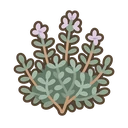
Let thyme flower at the bed edge and its small blooms often draw hoverflies, lacewings, and tiny parasitic wasps whose young feed on aphids. Its low mat also shades the soil surface without crowding the eggplant's root zone.
Fennel
Fennel roots release substances that stunt most garden vegetables, and eggplant is no exception. Grow it in its own corner or a separate pot well away from the bed, where its umbrella-shaped flower heads still feed hoverflies and tiny parasitic wasps.
Sweet Corn
Corn grows tall fast and is a heavy nitrogen user, so it often shades eggplant and drains the same soil. Eggplant needs full sun all day to set fruit, and shaded plants flower less and size up slowly.
Raspberry
Eggplant shares the wilt fungus of the rest of its family and leaves it behind in the soil. Since a raspberry row stands for a decade or more, it is worth siting it where no eggplant has grown for three years.
Give the tomato family 3 years away from this spot before any of its relatives return.
The pea and bean family, the onion family or the carrot family thrive in this ground next season.
Eggplant is a heavy feeder and leaves the bed depleted, with nightshade wilt organisms lingering in the soil. Keep tomato-family crops out for 3 years. Follow with legumes to rebuild nitrogen, then onion-family or carrot-family crops, which use the loosened, well-fed ground well.