Transplant outside
After last frost
Best in a permanent in-ground bed with a strong trellis or pergola; containers are not practical for mature vines. Space plants 120 inches (305 cm) apart.
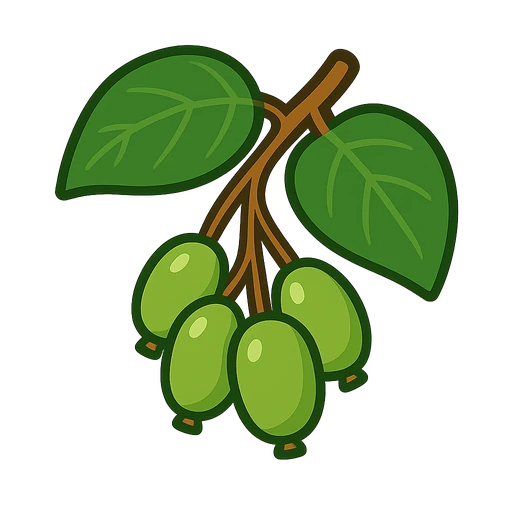
A vigorous, cold-tolerant woody vine producing clusters of smooth-skinned, grape-sized kiwi fruits eaten whole — no peeling required.
Actinidia arguta · also called Baby Kiwi, Cocktail Kiwi
After last frost, once soil has warmed to at least 50 °F (10 °C) and new growth is just beginning.
At least 6 weeks before first expected hard frost, to allow root establishment.
Hardy kiwi tolerates temperatures well below freezing, making it accessible to gardeners who cannot grow fuzzy kiwi. The vines are long-lived and, once established, yield abundantly with minimal intervention.
A little history. Native to eastern Asia, Actinidia arguta is a deciduous, dioecious (separate male and female plants) woody vine documented in flora records from Japan, Korea, and northeastern China. Most cultivars require a male pollinator plant.
Best in a permanent in-ground bed with a strong trellis or pergola; containers are not practical for mature vines. Space plants 120 inches (305 cm) apart.
Deep soak once or twice a week during the growing season; reduce to monthly during dormancy. Water when the top 2 inches of soil feel dry, or leaves show slight midday wilting in heat. Aim for about 1–2 inches per week including rain during active growth.
Side-dress (scatter fertilizer along the root zone and water in) once in early spring and again after fruit set. What to use: balanced 10–10-10 or compost-based fertilizer; avoid high nitrogen after midsummer to discourage late soft growth.
Prune hard in late winter while fully dormant: remove crossing canes, shorten laterals (side shoots off the main arms) to 4–6 buds. Summer-pinch vigorous shoots to 8–10 leaves beyond the last fruit cluster to redirect energy into fruit sizing.
It's ready when fruit yields slightly to gentle thumb pressure and detaches easily from the stem; skin color shifts from bright green to yellow-green or faintly bronze depending on cultivar. Taste-test: ripe fruit is sweet with no astringency. Harvest by hand in clusters, snipping the stem with clean scissors or pinching individual fruits free. Pick a small test sample first; if flavor is sweet and texture yields, harvest the full vine over 1–2 weeks as fruits ripen unevenly.
Refrigerate unwashed in a vented container for up to 3 weeks. At room temperature, ripe fruit holds 3–5 days. Freeze whole on a tray, then bag for up to 6 months.
Established vines are dormant-hardy to about -25 °F (-4 °C) with no protection needed. In the first 2 winters, mulch the root zone with 4–6 inches of straw and wrap the lower trunk if temperatures below -10 °F (-12 °C) are expected before the vine is fully established.
 Comfrey
Comfrey's deep taproot works well below the kiwi's shallower feeding roots, so the two rarely fight over water. Cut leaves can be laid on the root zone as mulch, and the plant stays put rather than climbing into the vine.
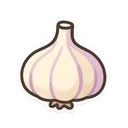 Garlic
Gardeners have long ringed young fruit vines with garlic in the belief that its strong smell hides them from browsing and sap-feeding pests. Treat it as a low-cost habit rather than protection you can count on, and keep bulbs 12 inches out from the trunk.
 Nasturtium
Nasturtium often pulls aphids onto its own stems and away from soft new kiwi shoots. It only helps if you pull and bin the infested plants once they are loaded, otherwise you have simply raised more aphids.
 White Clover
A low clover cover under the trellis shades the soil, holds moisture, and crowds out weeds that would otherwise need hoeing near the trunk. It also banks nitrogen that is released slowly in later seasons as the roots break down.
 Black Walnut
Many garden plants reliably struggle within the root zone of a black walnut, and a kiwi vine is a 20-year commitment you cannot easily move. Site the trellis well outside the walnut's branch spread, and further still if roots are known to run that way.
A perennial — it holds its spot for years, so it sits outside the annual rotation.
Hardy kiwi is a permanent vine, so it sits outside the yearly rotation and holds its bed for decades. It is a moderate feeder; keep it fed with compost rather than following it with anything. No family gap applies, and nothing rotates in behind it.
Set your garden's location and every window above becomes a real date — then Verdie reminds you when it's time to sow, transplant, water, and pick.